Back to Blog
  154
154

Over the past few years, we’ve experienced firsthand the astonishing pace at which LLM-based AI is advancing. Natural language understanding has reached a level nearly indistinguishable from human comprehension, and AI models have already proven production-ready for everyday tasks like basic problem-solving, document drafting, and code generation.
However, what happens when we ask AI to tackle a massive enterprise code base with hundreds of interconnected files, or a complex manual spanning thousands of pages all at once? Surprisingly, it quickly hits a wall.
“Explain how the core recommendation logic in this service
processes data to produce the final result.”
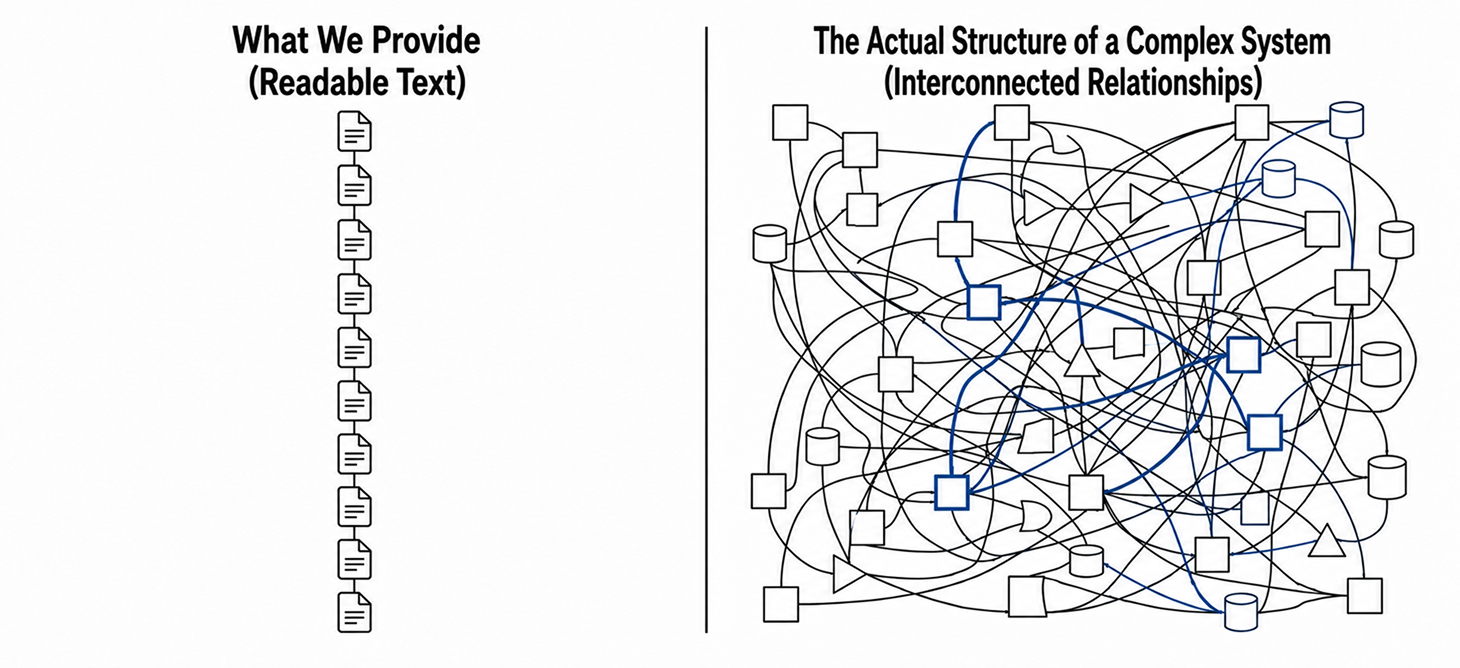
This is not a question you can answer by simply looking at a single file or a line of code. To trace the true cause-and-effect relationship, you must account for every single connection, from data ingestion and preprocessing logic to multi-model inference results and final business rules.
Current AI models, however, fail to grasp this end-to-end flow. Instead, they scan files in fragments. As a result, they miss critical structural connections and merely piece together whatever surface-level information happens to be visible. This explains why AI often provides plausible-sounding answers that lack core reasoning, or produces completely different responses to the exact same question.
This brings us to a fundamental question:
“Is the AI simply not smart enough? Or is there a flaw in how we supply information?”
Until now, we have fed information to AI as unstructured, monolithic text. But what truly matters is not the raw text itself, but the underlying relationships and structure within it. Context, such as which function calls which module or how one document links to another, is where real meaning resides.
To overcome this limitation head-on, developers are turning to graph-based approaches, with Graphify being a prominent implementation. Graphify stops treating data as disconnected text snippets. Instead, it transforms all information into a single, massive network graph made up of nodes (points) and relationships (lines). The resulting graph is far more than a simple data repository; it becomes a structure that holds true semantic meaning.
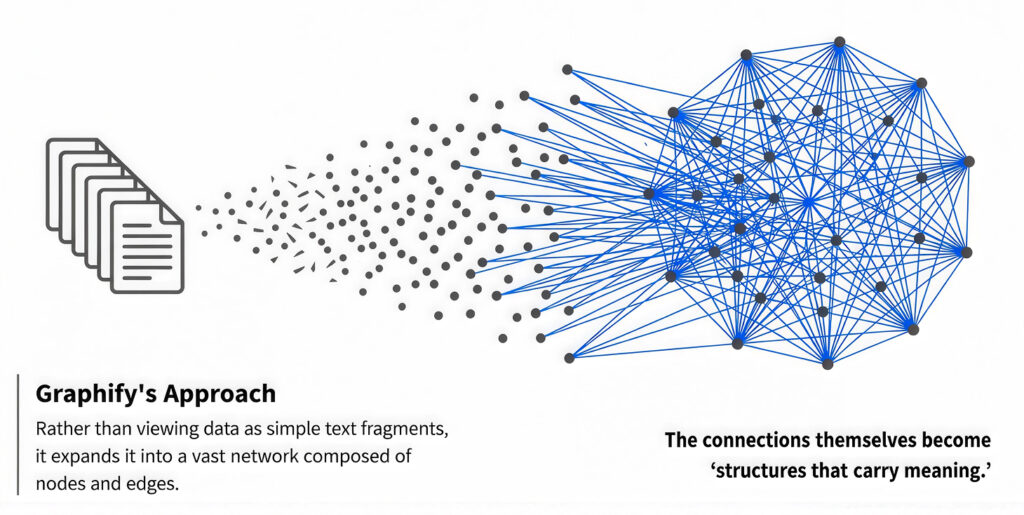
However, simply populating a dense graph is not enough. Within this complex network, we must identify what constitutes a meaningful cluster. In other words, rather than just representing complex structures, we need to reorganize them into a readable format. This is where the core technique comes into play: the Leiden Community Detection algorithm.
The Leiden algorithm is not merely a tool for grouping words that look similar on the surface. No matter how much data items appear to resemble one another superficially, the algorithm examines how tightly connected they actually are from within, separating them into cohesive units of meaning. It overcomes the limitations of traditional embedding approaches, which rely heavily on surface-level textual similarity, by evaluating the density of connections instead.
So, what exactly is community detection, the starting point of this remarkable transformation, and why does it differ from conventional classification techniques? Let’s dive in step by step.
What is Community Detection? “Birds of a Feather Flock Together”
When you look closely, data in our world is interconnected like a web. On social media, people are linked through friendships; web pages are connected by hyperlinks; and software code is intertwined through function calls. A mathematical representation of this web is what we call a Graph.
Within this complex network, the technique used to identify groups that are tightly linked together is called Community Detection.
Why is this concept so crucial? In complex systems, far more information lies in how elements relate to one another than in the individual elements themselves. For instance, looking at a specific function’s code tells you what it does. However, understanding its true importance or context within the larger system requires examining where it is called and what overall flow it belongs to.
In this regard, Community Detection is fundamentally different from traditional Clustering.
- Traditional Clustering: Treats data as simple vector values and groups items based on structural similarity or distance between keywords.
- Community Detection: Uses the underlying connectivity structure of the data as its baseline. In other words, the core focus is not how similar two elements look, but how densely they interact and connect with each other.
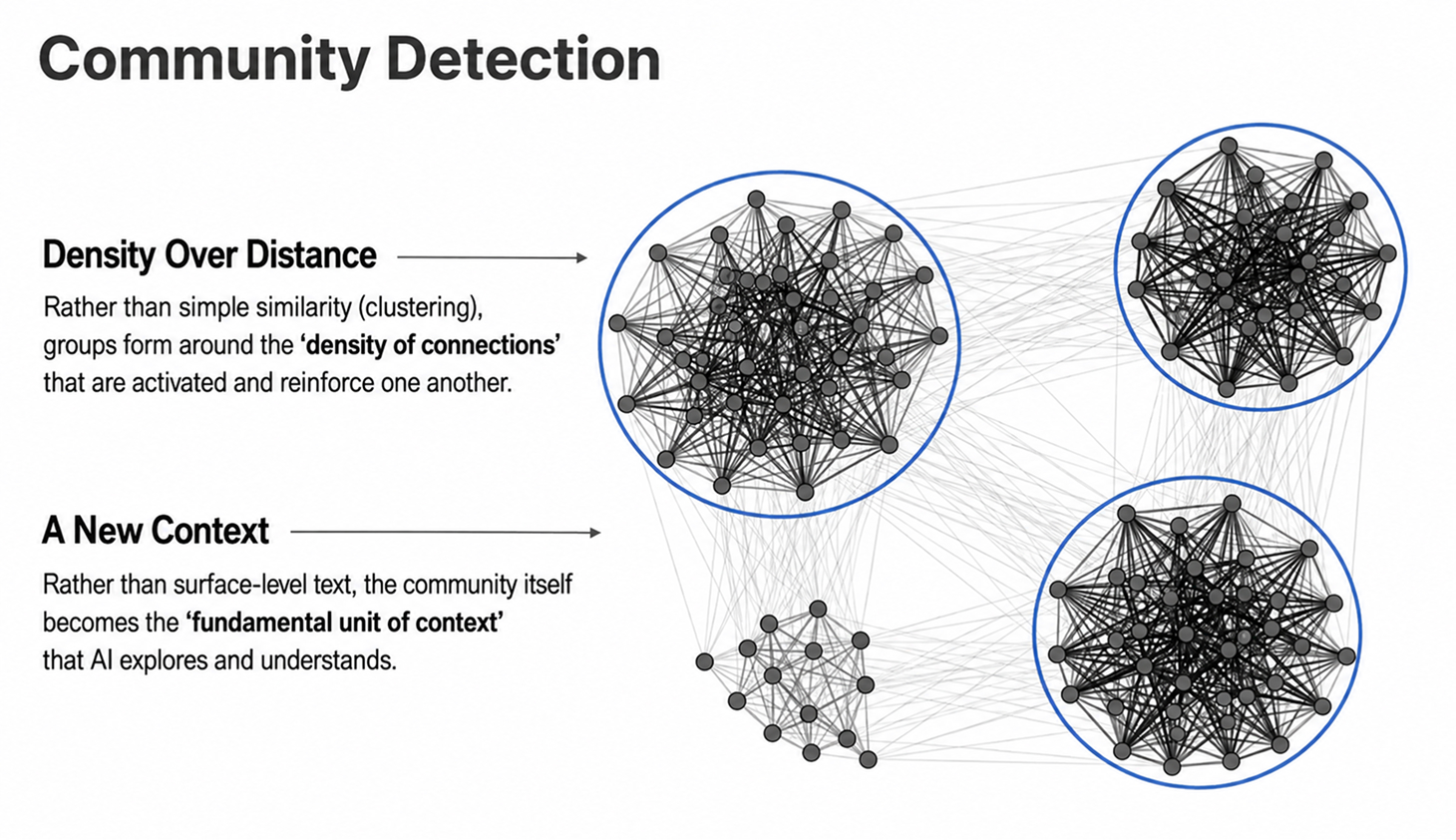
Let’s look at an example. On social media, grouping people simply because they all like football is clustering. On the other hand, identifying an active local group chat where members exchange messages and comments daily, even if their personal interests vary slightly, is community detection.
The same principle applies to software code. Rather than grouping functions merely because they share similar names, functions that frequently call one another and work tightly together are far more likely to form a genuine functional module. Understanding these organic relationships between data points is what we call structural understanding.
This perspective represents a massive paradigm shift for AI. Traditional LLMs deduce meaning by reading text sequentially, character by character or word by word. In a graph-based approach, however, meaning is defined within connections. An element’s true role is determined less by its own isolated text and more by how it connects to its surrounding ecosystem.
Ultimately, community detection is not just a simple data classification technique; it is a structural methodology for intelligently grasping complex, full-scale systems. And the true powerhouses driving this methodology forward are the Louvain and Leiden algorithms.
Modularity: “What Makes a Good Group?”
While the intuition that close-knit elements should be grouped together is easy to grasp, calculating this mathematically requires a precise metric. The foundational score serving as a compass here is Modularity. Think of it as a scorecard evaluating how well-constructed a community structure actually is.
The core concept behind Modularity is remarkably straightforward: “How much denser are the actual connections within this group compared to a random expectation?” In other words, when compared to a randomly shuffled network, if a specific group contains far more internal connections than expected, we consider it a genuine, meaningful community.
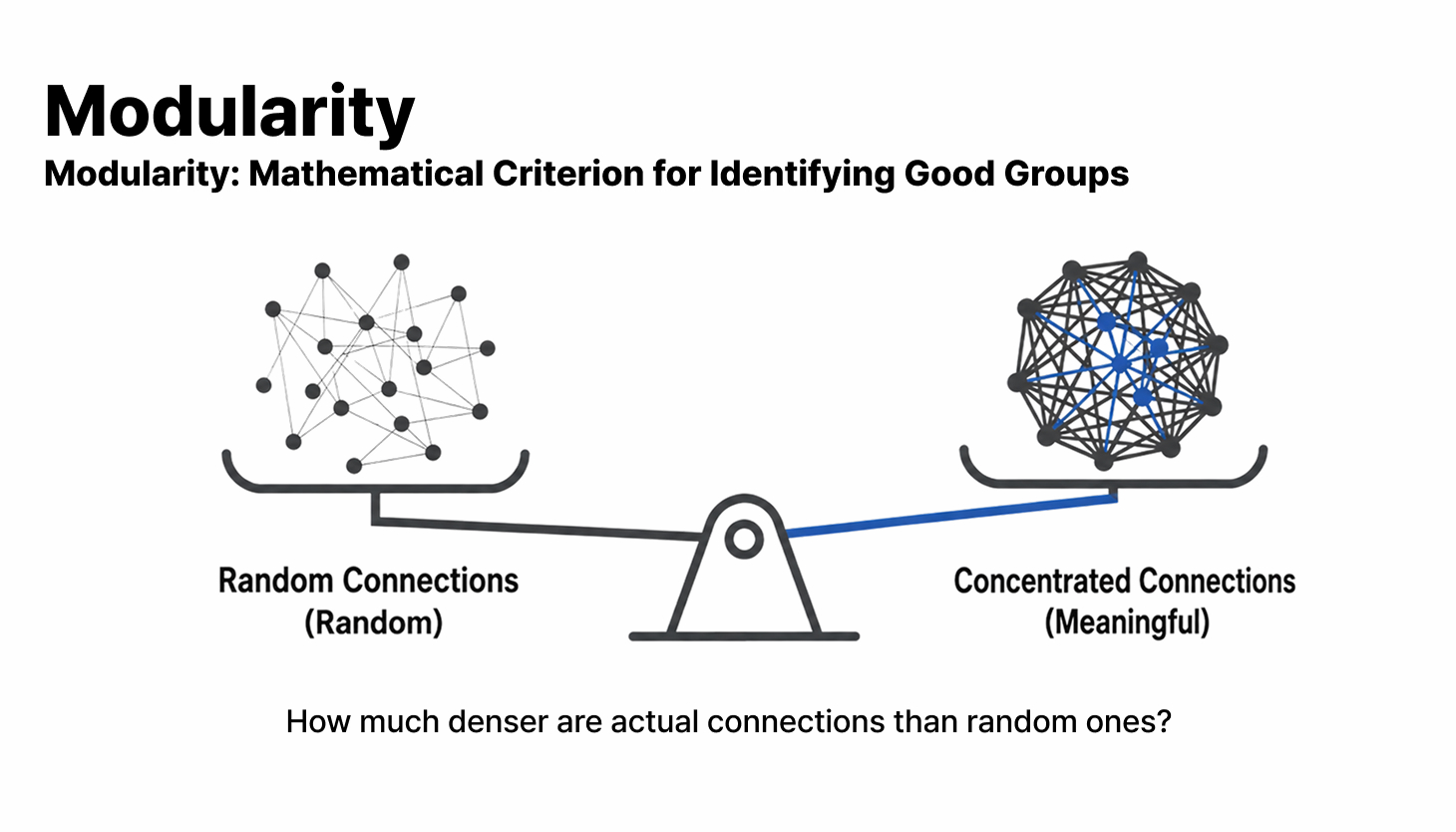
To put it more intuitively: if you divide people in a room completely at random and still happen to find many acquaintances inside each small group, that is likely sheer coincidence. However, if internal conversations spike and connections heavily concentrate only when you partition the room in a specific way, there is clearly a meaningful context behind that structure. Modularity quantifies this exact difference between pure chance and structural intent.
This metric serves as the primary target score for both the Louvain and Leiden algorithms. While their mechanics differ, both share the ultimate goal of maximizing this Modularity score. Simply put, it is a process of finding an ideal grouping where internal cohesion is maximized (dense internal links) and external noise is minimized (sparse external links).
However, there is an important caveat: as powerful as Modularity is, it is by no means a flawless metric.
Because of how the score is calculated, it inherently favors communities of a certain scale. This introduces a critical constraint where extremely small clusters or massive groups often go undetected—a phenomenon known in academia as the resolution limit.
Furthermore, relentlessly driving up this Modularity score does not always yield a flawless structure. In practice, engineers using the Louvain algorithm discovered a troubling side effect: communities that achieved peak Modularity scores on paper actually harbored disconnected internal islands upon closer inspection. The mathematical score, in essence, created a loophole for poorly connected groups. And this exact flaw provided the decisive catalyst for the creation of the Leiden algorithm.
Ultimately, while Modularity represents a revolutionary starting point for community detection, it remains incomplete on its own. Uncovering truly healthy, high-quality structures requires an algorithmic approach that looks beyond mere score maximization, setting the stage for the evolution from Louvain to Leiden.
Louvain Algorithm: A Fast and Practical Starting Point
Introduced in 2008, the Louvain algorithm was long regarded as the de facto standard for community detection. It gained widespread adoption because it was fast, simple, and exceptionally practical—capable of uncovering meaningful clusters across complex graphs with millions of data points in the blink of an eye.
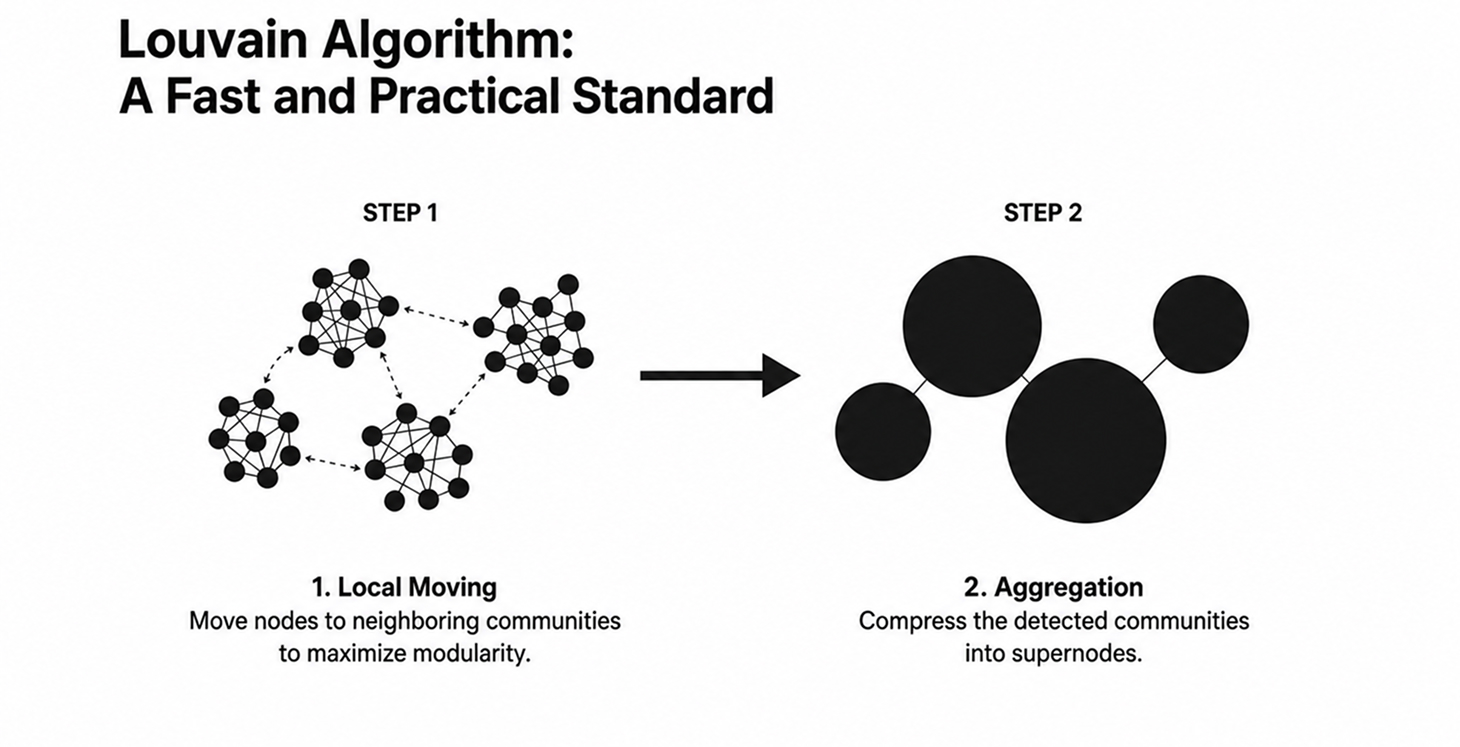
At the heart of this algorithm is a process of “moving rooms based on your neighbors.”
- Initially, every piece of data (node) lives alone in its own isolated room.
- Each node looks around at its neighbors and considers:
“If I move into that room next door, will our overall Modularity score go up?” - If joining that neighbor improves the total score, the node relocates without hesitation.
- As every node repeats this evaluation, tightly knit groups begin to form naturally.
In more concrete terms, this process unfolds in two main phases: Local Moving, where individual nodes relocate to the most fitting neighbor’s group, and Aggregation, where formed groups are compressed into single community-level nodes. The algorithm then iterates this exact process on the newly compressed graph, gradually building up larger, higher-level macrostructures.
This is analogous to making sense of a complex municipal map by aggregating neighborhoods into districts, and districts into cities. Thanks to this hierarchical abstraction, Louvain processes massive datasets efficiently without running out of steam.
However, a critical vulnerability lies beneath this powerful mechanism.
Because the algorithm focuses purely greedily on maximizing the overall Modularity score, it can create shell communities that look sound on the surface but are actually internally disconnected. It exposes a flaw by forcing completely unrelated, unlinked fragments into the same group simply because doing so nudges the score upward.
This issue is far more than a minor computational glitch. It is especially fatal for graph-based AI systems that rely on network structures to interpret context, as poorly grouped communities ultimately feed flawed context to the AI model. Furthermore, once an improper grouping decision is made in the early stages, it gets locked in during aggregation with no mechanism to revisit or correct it later.
Ultimately, the essence of the Louvain algorithm can be summarized as follows:
“It excels at partitioning rooms quickly, but it cannot guarantee whether those rooms were partitioned correctly.”
This leaves us with a fundamental question that prioritizes structural integrity over sheer execution speed:
“Are we looking for loosely grouped clusters, or the true, living structures embedded within our data?”
The definitive answer to this question arrives in the form of the Leiden algorithm.
Leiden Algorithm: “The Minimum Requirement for Truly Understanding Structure”
The Leiden algorithm emerged specifically to overcome the fatal limitations of the Louvain algorithm. The core question Leiden poses is remarkably simple:
“If a cluster claims to be a true community, shouldn’t its members at least be connected to one another?”
This question might sound obvious, but the Louvain algorithm guarantees no such condition. So long as the Modularity score went up, Louvain would lump together nodes that were entirely disconnected in reality.
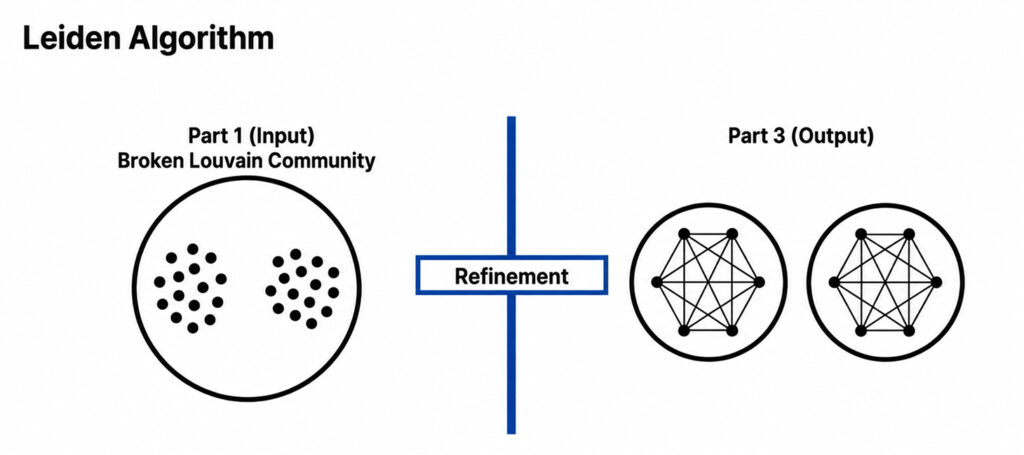
To solve this, Leiden inserts a meticulous filter directly into Louvain’s workflow: the Refinement phase.
Comparing the two workflows makes Leiden’s innovation immediately clear:
- Louvain: Local Moving ➔ Aggregation
- Leiden: Local Moving ➔ ★Refinement (Internal Validation & Filtering) ➔ Aggregation
Both algorithms start similarly in the Local Moving phase, where nodes move into neighboring rooms. However, Leiden does not compress those results right away; it validates them first.
It closely examines whether a room forms a cohesive structure or if it is merely a collection of fragmented pieces forced together just to boost the score. During this step, weakly linked or disconnected components are decisively separated. Only the nodes that share genuine internal connectivity are preserved to rebuild a truly robust structure.
This is not post-processing merely meant to inflate numbers; it acts as a sophisticated filter that reaches a deeper understanding of the network’s structural topology.
Thanks to this Refinement step, communities generated by Leiden offer distinct advantages:
- Guaranteed Connectivity: The interior of a community is never fragmented, ensuring every member remains tightly linked.
- High Stability: Unlike Louvain, whose outputs could fluctuate slightly across runs, Leiden converges reliably onto the most stable structure where no further node movement is needed.
- Surprising Execution Speed: While adding a validation phase might seem like it would slow things down, clever algorithmic optimizations allow Leiden to run at speeds comparable to, or even faster than, Louvain.
Ultimately, Leiden is far more than an incremental update to Louvain. It redefines what actually qualifies as a community. And this distinction becomes crystal clear in structure-based AI systems like Graphify, because these communities form the exact units of context through which AI interprets data.
Moving beyond a basic data classifier, the Leiden algorithm serves as a core engine for AI, determining what constitutes a single, fully cohesive unit of meaning.
Louvain vs Leiden: What Has Fundamentally Changed?
When placing the Louvain and Leiden algorithms side by side, they may seem quite similar on the surface. Both optimize the Modularity score and share the overarching framework of grouping and compressing nodes. Beneath the surface, however, lies a clear divergence in philosophy.
To help clarify these distinctions, we can break down their fundamental differences into three key areas:
① Score-Centric vs. Structure-Centric
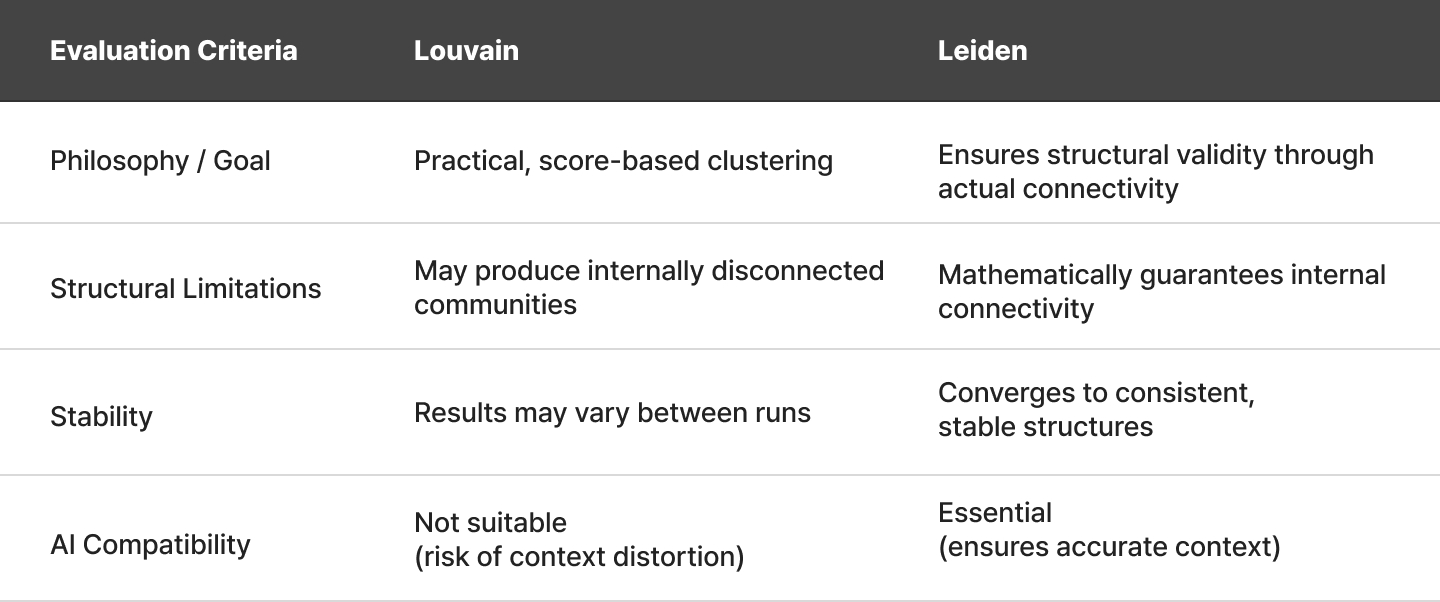
- Louvain: A score-centric algorithm prioritizing speed and scalability. Designed to process massive graphs rapidly, it operates greedily by making choices that yield the highest immediate score boost at each step. While practical, it does not explicitly verify whether the interior of a community is well connected. Consequently, it can yield flawed structures that look impressive mathematically but are empty inside.
- Leiden: Anchored firmly in structural integrity. This rationale underpins its dedicated Refinement phase. Rather than chasing numbers on a scoreboard, Leiden evaluates internal cohesion to construct communities that are structurally sound and genuine.
② Divergent Perspectives
The two algorithms view the concept of community through entirely different lenses. Louvain perceives a community simply as a group that scores well, whereas Leiden sees it as a living, tightly knit structure defined by real connections. This shift in perspective shapes the ultimate quality of the output.
③ Result Stability
In production systems, stability is a critical factor, and here the gap widens further. Louvain outputs can fluctuate between runs and display sensitivity to minor data shifts. In contrast, Leiden converges reliably onto consistent, optimal outcomes even across multiple runs. In actual production environments where predictability is essential, this predictability is a decisive advantage.
As a result, the vast majority of modern graph analysis platforms adopt Leiden as their default choice. While Louvain remains a quick baseline, Leiden has established itself as the global standard for high-precision data analysis and for building structural backbones for AI training.
Key Comparison Matrix: Louvain vs. Leiden
Graphify: Why Leiden Is Essential for AI Systems
This progression might appear as just another technical evolution in graph algorithms. However, these algorithms truly shine when integrated into AI architectures, particularly in structure-based context processing approaches like Graphify.
Graphify’s core premise is straightforward: understand data as a graph rather than plain text. Source code, documents, images, and videos are visualized as nodes and edges, extracting authentic meaning directly from their underlying network topology.
Crucially, Graphify does not rely solely on traditional vector embeddings. Moving beyond surface-level textual similarity, it evaluates true context through the underlying causal relationships and structural connections embedded in the data.
Community detection acts as the heart of this workflow, with the Leiden algorithm operating at its core. Running Leiden across Graphify’s expansive network groups data into natural clusters based on connection density.
A particularly compelling dimension is the use of Semantic Edges. Beyond hard structural links, such as function call chains, Graphify incorporates semantic similarities identified by LLMs directly as edges within the graph. The Leiden algorithm then handles both structural and semantic connections in a single, unified graph to extract precise community structures.
This approach marks a major paradigm shift compared to traditional Retrieval-Augmented Generation (RAG) pipelines:
- Traditional RAG Systems: Mechanically slice documents into chunks and retrieve text pieces based on keyword or embedding similarity. This frequently leads to fragmented, discontinuous context.
- Graphify Architecture: Leverages the graph itself as context, preserving rich causal relationships. Instead of searching for fragmented text pieces, the AI navigates context using a structured map.
The takeaway is clear: the paradigm for AI information processing is evolving from simple similarity-based retrieval to structure-based navigation. And at the center of this shift, the Leiden algorithm guides the way for AI.

Real-World Applications: When Tools Become Structural Understanding
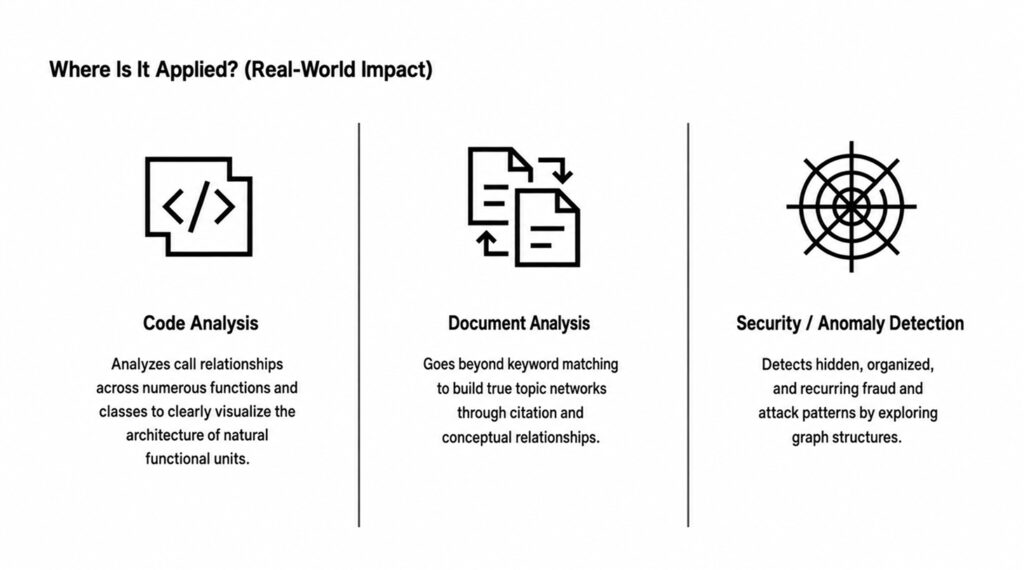
While the theory may seem complex, this approach is already widely adopted in data domains where structure is paramount. Its impact is particularly pronounced across three key areas:
- Code Analysis: In massive codebases, countless functions and classes are interconnected, making it nearly impossible to grasp the overall architecture through plain text alone. Applying community detection naturally groups functional modules based on actual dependency graphs. This directly streamlines refactoring, system diagnostics, and developer onboarding.
- Document Analysis: Classifying hundreds of documents using simple keywords catches only surface-level similarities. Conversely, forming communities based on citation networks or conceptual links surfaces cohesive document groups that share authentic context and thematic relevance.
- Security & Anomaly Detection: Representing financial transactions or user behaviors as graphs yields dramatic results. Fraud rings and advanced threats exhibit distinct, densely linked connectivity patterns that easily bypass standard anomaly detection but are captured through community detection.
Final Decision Criteria for Engineers
For engineers, the decision framework between the two algorithms is straightforward:
“Speed is the absolute priority, and a high-level heuristic overview suffices” ➔ Louvain Algorithm
“Precision analysis is required, or the output serves as context for AI systems” ➔ Leiden Algorithm
When the core criteria centers on whether a partitioned structure is truly valid, Leiden becomes the natural choice. Especially for systems like Graphify that feed refined community topologies directly into AI as contextual backbones, the Leiden algorithm is a strict necessity rather than an optional feature.
Conclusion: AI Evolves from Reading Text to Navigating Structures
Ultimately, the discussion surrounding Louvain and Leiden algorithms extends beyond simply grouping data neatly. It reflects an ongoing effort to endow machines with a human-like, nuanced understanding of large, complex systems.
For years, the Louvain algorithm served as an invaluable workhorse in production environments due to its exceptional processing speed, effortlessly handling massive datasets. Yet as performance standards rose, a fundamental truth became clear: partitioning data correctly from the start yields far more value than partitioning it quickly and loosely.
This realization catalyzed the creation of the Leiden algorithm. Rather than chasing raw scorecard metrics, Leiden engineered a common-sense requirement into reality: ensuring that separated clusters remain internally cohesive and meaningful.
This paradigm shift aligns directly with the strategy behind Graphify and the broader AI ecosystem. Modern AI is no longer a simple assistant that mechanically ingests disconnected text chunks to output generic summaries. It is rapidly evolving into a system that:
- Deeply comprehends underlying causal connections within data,
- Navigates intelligently across densely linked knowledge maps, and
- Reasons precisely using self-contained, highly cohesive units of meaning.
The decisive competitive edge in the upcoming AI era can be summarized in a single takeaway:
The era of quantitatively flooding AI with raw context has ended. Future capabilities will be defined by how densely and precisely that information is structured. And guiding AI so it never loses its way are intelligent, structure-first algorithms like Leiden.