Back to Blog
  198
198

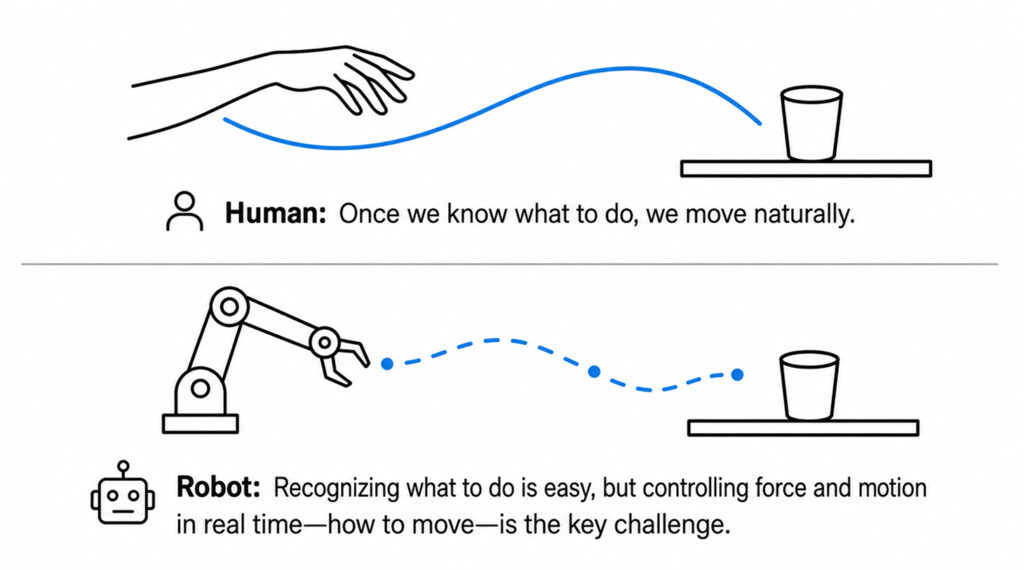
Modern AI seamlessly writes text and comprehends images. Yet guiding a physical robot body to move naturally in the real world remains a formidable barrier.
The fundamental difficulty of robot control lies in the vast gap between perception and physical action. Even when a system fully understands its visual surroundings, calculating real-time force control at the fingertips and predicting safe trajectories requires a fundamentally different computational paradigm.
Historically, robotics relied heavily on imitation learning, where robots copied human demonstrations. However, this approach suffered from a critical limitation. If a human demonstrator grasped an object from the left in some trials and from the right in others, traditional models mathematically averaged these trajectories. Consequently, the robot reached into empty space right between the two valid paths, failing completely. This issue is technically known as the Mode Blurring problem.
Diffusion Policy emerged as a breakthrough solution to this challenge. Rather than forcing a single deterministic answer, Diffusion Policy allows the robot to learn multimodal probability distributions over multiple action candidates simultaneously. As a result, robotic motion became vastly more flexible and adaptive.
The Speed Bottleneck Facing Diffusion Policy
Despite its strengths, Diffusion Policy encountered a critical bottleneck when deployed in real-world physical environments: slow inference speed.
Diffusion models inherently start from pure random noise and iteratively refine the output over tens of computational steps to generate a valid trajectory. While this multi-step process allows the model to capture diverse action possibilities, it creates substantial latency for generating a single action candidate.
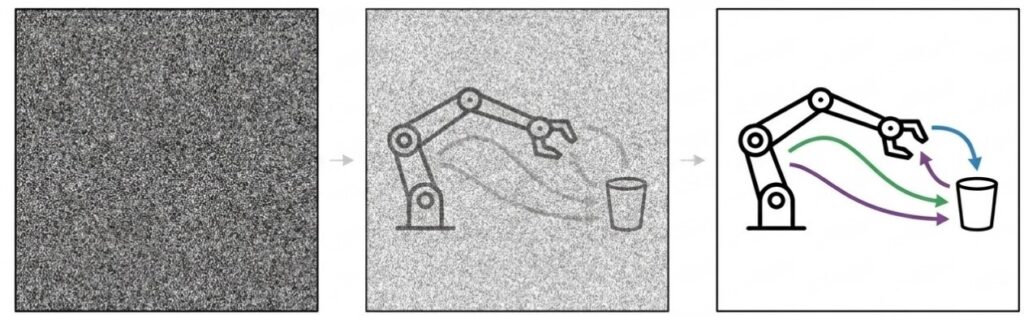
For physical robots, this latency poses a severe problem. Achieving smooth, jitter-free physical motion requires generating real-time motor control signals at high frequencies of 10 Hz to 100 Hz. Matching this operational frequency using standard diffusion sampling speeds proved nearly impossible.
Engineers attempted workaround strategies such as predicting chunks of future actions in advance and executing them sequentially. However, if an unexpected physical perturbation occurred mid-execution, the robot could not react instantly, leading to freeze states or mechanical collisions.
Ultimately, robotics researchers hit a clear wall: Diffusion Policy yielded precise, highly capable movement, but ran far too slowly for real-time physical control. This led researchers to a fundamental question: ‘Must we iterate through dozens of noisy computational steps, or can we construct a direct trajectory to the target action?’ This core challenge paved the way for Flow Matching.
Flow Matching: Straightening Curved Paths into Direct Shortcuts
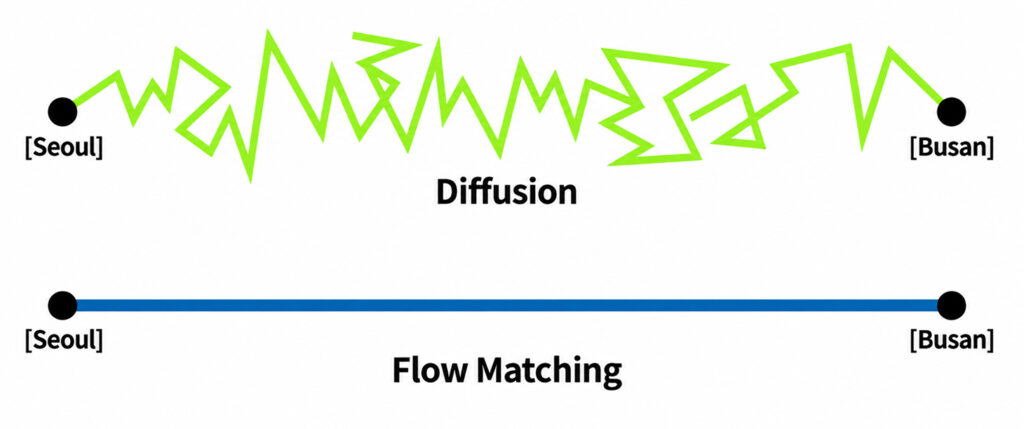
Flow Matching may appear structurally similar to Diffusion, yet it designs the trajectory to the target output in a fundamentally different way. Where Diffusion stumbles along complex, curved paths through iterative steps to reach the target, Flow Matching explicitly learns to straighten the trajectory between noise and action into a direct vector field.
Consider a simple analogy. Traveling from Seoul to Busan via Diffusion is like making dozens of complex turns along winding roads. Flow Matching, by contrast, maps the overall space first and then drives straight along the fastest direct path.
This mathematical formulation provides game-changing advantages when controlling physical hardware:
- Substantially Faster Latency: Because the velocity vector field is optimized into nearly straight paths, models can synthesize exceptionally high-quality actions in just a few computational steps (fewer sampling steps) rather than tens of iterative loops.
- More Stable Training Dynamics: Instead of learning complex probabilistic formulations to remove noise step-by-step, the neural network simply learns ‘which direction to push the state vector directly,’ rendering the training process far more intuitive and stable.
- Fluid and Smooth Execution: Physical motion is inherently a continuous flow. Flow Matching aligns natively with this characteristic, yielding vastly smoother, natural action flows for robotic arms and end-effectors.
π₀: Flow Matching Embodied in the Physical World
Physical Intelligence’s π₀ (pi-zero) represents the first milestone successfully transplanting the theoretical elegance of Flow Matching into complex physical hardware.
Architecturally, π₀ organically pairs a massive Vision-Language Model (serving as the cognitive brain) with a Flow Matching module (serving as the motor muscle). Visual understanding and physical execution are connected end-to-end within a unified foundation system.
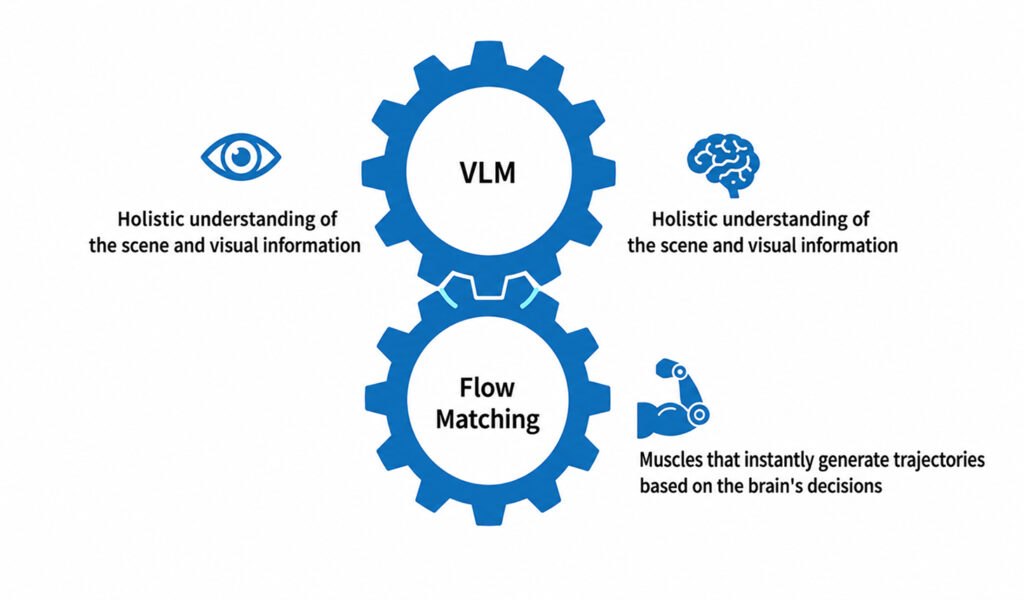
Crucially, π₀ also utilizes Action Chunking to output sequences of future states. While Action Chunking previously compromised real-time responsiveness in diffusion-based systems, π₀ circumvents this flaw through high-frequency replanning made possible by Flow Matching’s rapid execution speed. Rather than executing predicted chunks blindly, π₀ recalculates and overwrites future trajectories in real time at frequencies reaching up to 50 Hz.
When folding laundry or performing intricate household tasks, the system does not stutter. Instead, it fine-tunes its trajectory 50 times per second, yielding fluid continuous physical motion. This breakthrough bridges theoretical models with strict real-time physical latency requirements.
A Paradigm Shift: Seeing and Moving Simultaneously
The true innovation brought by π₀ and Flow Matching lies in dissolving long-standing boundaries within traditional robotics architecture.
Classical control stacks strictly partitioned cognition into discrete sequential stages: Perception, followed by Planning, followed by Execution. Under this modular paradigm, a minor perception error or an unexpected physical obstacle mid-task caused the entire pipeline to fail or freeze.
The emerging paradigm unites perception and physical action into a continuous real-time loop. Rather than waiting for complete perception before planning and moving, the system continuously adjusts motor outputs in direct response to real-time sensory inputs.
Consider how humans grasp a cup. We do not compute precise mathematical coordinates before moving our arm. Instead, we extend our hand, visually track the cup’s position, and make micro-adjustments at our fingertips on the fly. This intuitive human control paradigm is finally realized through modern embodied AI models.
Post-π₀ Directions and Remaining Engineering Challenges
This paradigm shift is not a passing trend, but an irreversible trajectory. Thanks to the computational efficiency of Flow Matching, embodied AI is rapidly leaving research labs to enter real-world environments, tackling domestic chores, object sorting, and close-range human-robot collaboration.
Yet to build systems that achieve uncompromising operational reliability in production environments, critical engineering bottlenecks must still be resolved.
- Safety and On-Device Deployment: While flow-based generative models offer unprecedented dexterity, they carry a non-zero probability of generating unpredictable or hazardous motor signals. In shared human workspaces, a single trajectory error can lead to physical damage. Additionally, reducing computational resource overhead to run these models natively on edge devices while maintaining low hardware cost remains a core commercialization hurdle.
- Prohibitive Physical Data Acquisition Costs: Unlike pure language models that scale on raw web text, physical AI demands real-world embodied trajectory data. Capturing these physical interaction trajectories via human teleoperation remains exceptionally expensive and hard to scale.
- Out-of-Distribution Generalization Limits: Even with continuous trajectory generation, performance degrades when encountering drastically novel household objects, extreme lighting shifts, or unfamiliar friction dynamics. Achieving the intuitive zero-shot adaptability characteristic of human motor control remains an open challenge.
Physical AI is transitioning rapidly from discrete action tokenization to high-frequency continuous flow generation. By marrying deep semantic reasoning with continuous vector field synthesis, modern robotics is steadily closing the gap between thinking and acting.
Toward General Physical Intelligence
To be sure, industrial environments where absolute hardware safety remains paramount will continue relying on hybrid architectures that strictly segregate high-level AI reasoning from deterministic safety control modules for the foreseeable future.
Nevertheless, one reality is undeniably clear. Within the evolution of robotics, this architectural shift marks an explicit milestone.
- Behavior Cloning taught robots how to imitate humans precisely.
- Diffusion Policy provided robots with flexibility to consider multimodal possibilities rather than sticking to a single deterministic path.
- Flow Matching has begun enabling real-time efficiency to synthesize the fastest, most natural movements in real-world environments.
In the past, every industrial robotic arm and vacuum robot required isolated, specialized control models. Yet, just as large language models unified human text across the globe, a grand narrative has begun in robotics to unify physical motion under a single architecture.
In the near future, we will encounter true General Physical Intelligence in production environments, systems that autonomously comprehend unseen context and synthesize optimal action flows rather than merely repeating hardcoded tasks. Flow Matching stands as a crucial leap forward on this extraordinary journey.