Back to Blog
  2,039
2,039

The Opening of the Agentic Mesh Era
In February 2026, the AI industry reached a massive paradigm shift beyond simple performance improvements. The starting gun was fired on February 5, when Anthropic’s Claude 4.6 Opus and OpenAI’s GPT 5.3 Codex were released just minutes apart. This was followed on February 12 by Google’s Gemini 3 Deep Think upgrade, further accelerating the momentum.
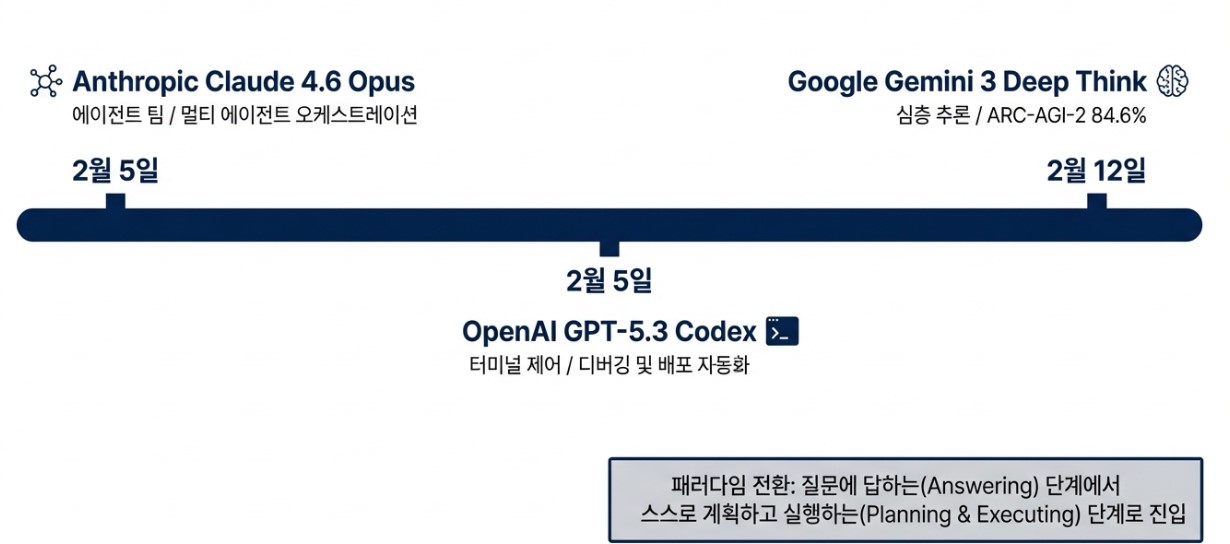
This series of innovations clearly demonstrates that AI’s role is transitioning from a conversational chatbot to an Autonomous AI Agent capable of planning and execution. We have entered the Agentic Mesh ecosystem, where AI no longer waits for instructions but independently designs complex workflows and interacts with multiple systems. This is a strategic inflection point that will reshape corporate revenue structures and operations.
An Agentic Mesh is a decentralized intelligence structure where multiple AI agents connect like a single organic team. They discover each other, communicate, share context, coordinate decisions, and operate securely under defined policies.

Gartner’s 2026 outlook predicts that the share of applications with embedded task specific agents will skyrocket from less than 5% in late 2025 to 40% by the end of 2026.
Big Tech’s LLM Expansion: Agent Support Based on General Models
Global Big Tech companies leading the LLM market are evolving their flagship models beyond simple chatbots into agents at an operating system level, building exclusive ecosystems in the process. This massive paradigm shift, which Big Tech firms in Silicon Valley and across the globe are betting their futures on, can be categorized into four technical trends and one ultimate business goal.
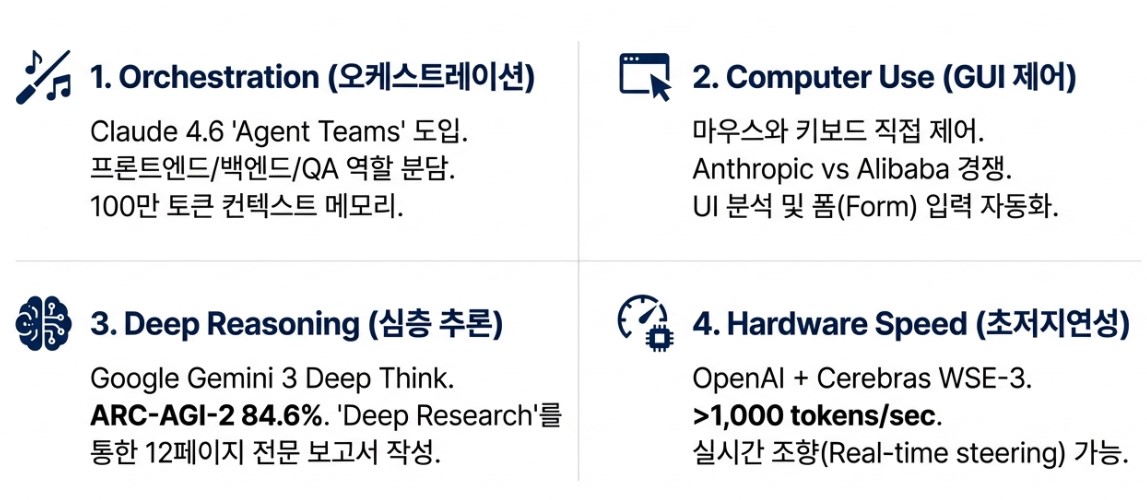
The most noticeable change is the emergence of Autonomous Collaboration and Multi Agent Orchestration, ending the era where a single AI carried the entire workload. Anthropic introduced an Agent Teams feature in Claude 4.6, allowing it to delegate roles such as frontend, backend, and QA to sub agents for parallel processing. Based on a vast memory capacity of 1 million tokens, it demonstrates the persistence to review and coordinate code among agents even in long term projects. Similarly, OpenAI has evolved GPT 5.3 Codex into an autonomous software engineer that completely controls terminal environments rather than remaining a simple coding tool. It debugs its own training processes and manages deployments, allowing users to lead multiple agents in real time from a command center without writing code themselves.
The second trend is GUI Based Direct Action and Computer Use Capabilities, where AI moves beyond text boxes to see monitor screens and directly control mice and keyboards like a human. This field is seeing the most intense global competition to challenge the dominance of US Big Tech. Alibaba of China is in close pursuit with its powerful visual agent, Qwen 3.5. Given only UI screenshots, it independently analyzes the screen to fill out web forms and change system settings, performing multi step workflows without hesitation. In response, Anthropic showcased its Computer Use feature, which navigates Excel and manipulates websites without separate API integrations.
Third is the Overwhelming Reasoning and Ecosystem Integration led by Google. Beyond simple sentence generation, Google has realized true intellectual labor by combining human level deep thinking with its vast data ecosystem. Serving as the smartest brain, Gemini 3 Deep Think approached human levels with a record of 84.6% on the ARC AGI 2 benchmark, solving the most difficult math and physics problems through deep internal reasoning. This is paired with Deep Research, an agent that can generate a complete 12 page professional report including interactive charts and citations from a single query. Furthermore, it has established itself as a complete digital employee by integrating with Google Drive or Gmail to write reports autonomously and using Chrome’s Auto Browse feature to perform complex web surfing.
The fourth trend is securing Hardware Infrastructure Optimization and Ultra Low Latency to ensure these agents can move as quickly as a user’s own hands and feet. For real time response, OpenAI introduced the GPT 5.3 Codex Spark model, which fully adopts the Wafer Scale Engine (WSE 3) from emerging hardware leader Cerebras. As a result, it achieved a phenomenal speed of over 1,000 tokens per second, enabling Real time steering where humans can immediately intervene to correct the AI’s direction mid task. This has opened the era of true real time collaboration.
Finally, and perhaps most importantly, the ultimate destination of all these massive technological advancements converges toward a clear business objective: Overcoming the Generative AI Paradox and Achieving Monetization. By 2025, numerous companies had invested vast amounts of capital into AI adoption, yet their actual financial performance remained minimal. To break through these limitations, Big Tech has completely pivoted toward the Agentic Mesh ecosystem. This moves beyond simple assistive tools to autonomously complete more than 60% of corporate business processes. Building a perfect digital infrastructure that guarantees clear profitability for enterprises is the ultimate purpose of this autonomous agent innovation.
Specialist Survival Strategy: Agentic Workflow and Efficiency
While Big Tech focuses on the macro strategy of dominating the AI Operating System, AI agent specialists are adopting a completely different set of rules to move quickly and nimbly within that ecosystem. While giants pour astronomical costs into building the Foundation Model, these specialists rely on Vertical Integration and Cost Efficiency as their primary weapons. They are betting their survival on solving specific business problems and proving tangible Return on Investment (ROI) rather than simply reselling third party APIs.
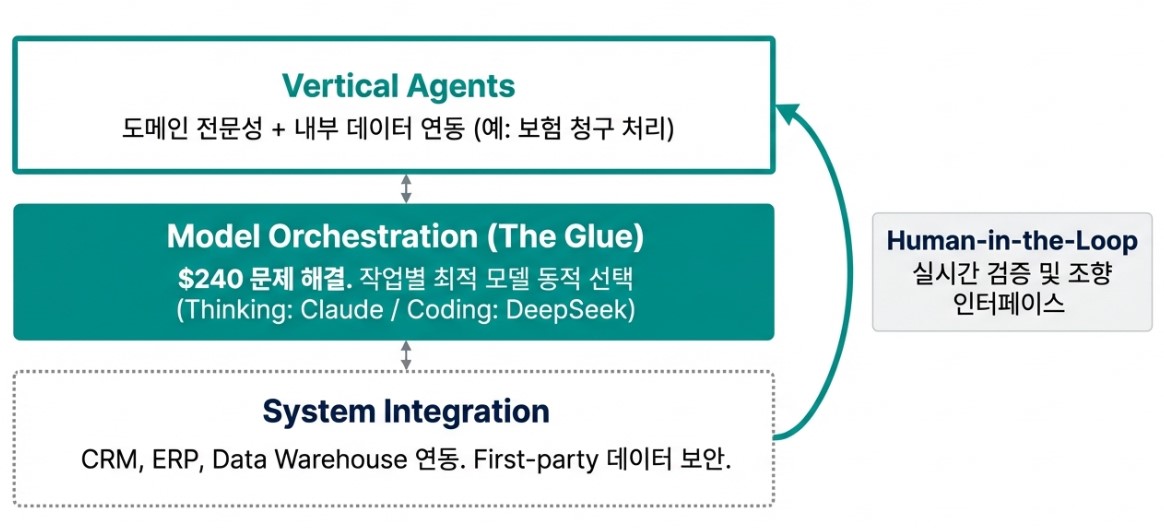
Vertical Agents Instead of General AI
The first weapon used to penetrate the gaps left by Big Tech is the Vertical Agent tailored for specific industries. While general models like ChatGPT or Claude offer broad but shallow knowledge, they often struggle to complete complex, professional tasks autonomously. In contrast, specialist firms integrate actual corporate internal data based on overwhelming domain expertise. While a general AI might explain basic marketing concepts, a specialist agent can pinpoint the customer groups with the highest revenue potential for the next 18 months and suggest customized campaigns. In the insurance industry, they go beyond summarizing emails to achieve End to End completion: extracting documents, reviewing regulations, drafting final quotes, and updating internal systems without human intervention.
Intelligent Model Orchestrators
Second, these companies act as Intelligent Model Orchestrators that combine the strengths of various models rather than relying on a single expensive one. They might assign high level reasoning tasks like architectural design to the powerful Claude Opus, while delegating simple data preprocessing or code generation to cost effective models like DeepSeek or GPT 5.3 Codex. This addresses the $240 Problem, the subscription fatigue companies feel when paying for multiple AI services. By designing a single interface that calls only the necessary models on demand, they drastically lower the cost of AI adoption.
The Glue Between Fragmented Systems
No matter how smart an AI is, it is useless if not connected to real world data. Specialist firms act as the Glue that connects fragmented systems. Instead of developing the AI models themselves, they focus on building the robust infrastructure piping that allows those models to communicate in real time with a company’s CRM, ERP, or data warehouse. To handle sensitive first party data that general AIs might be restricted from accessing, they provide a rock solid governance environment with strict access controls and full traceability of all AI actions, earning the deep trust of enterprises.
Human in the Loop Interfaces
Finally, for companies still hesitant about full autonomy, specialists build sophisticated Human in the Loop interfaces based on the philosophy that humans ultimately bear responsibility. They support real time steering, allowing practitioners to intervene and change direction mid task, and design UI/UX where the AI proactively asks questions in ambiguous situations. This creates a multi dimensional collaboration process where an AI drafts content, a human marketer refines the strategy, and another verification AI performs fact checking.
The survival strategy for AI agent specialists is clear. They leave the heavy weight battle of who can build the smartest brain to Big Tech. Instead, they focus entirely on how to seamlessly, affordably, and safely land that intelligence into actual business fields. This is the secret to how they are building their own solid ecosystems even among the giants.
Comparative Analysis of the Two Technological Trends
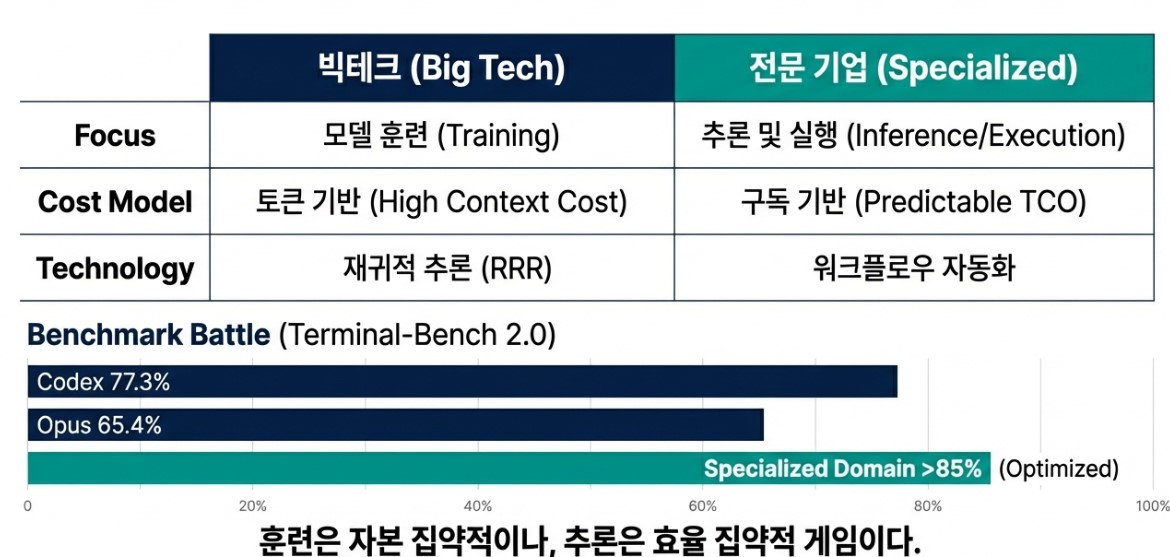
The General Integrated models of Big Tech and the Specialized Efficient models of specialist firms form the two major pillars of the 2026 AI engineering stack.
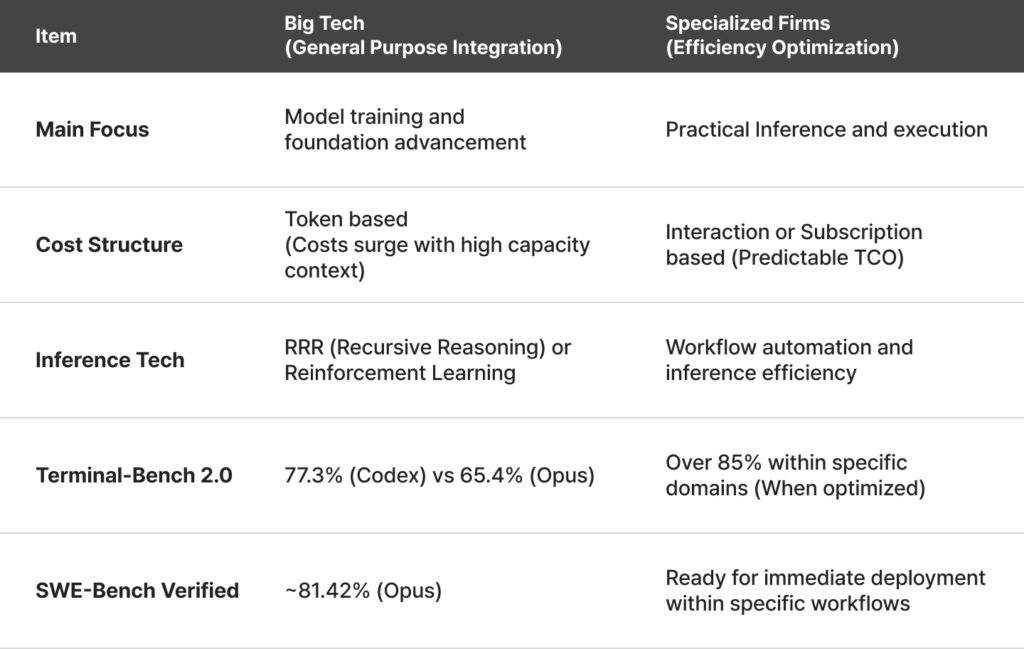
[Analysis Results] While the training market is dominated by Big Tech leveraging massive capital, the inference market—the true volume game—will be the ultimate battleground where efficiency-driven agentic technology and cost optimization capabilities determine market share.
The Leap of Chinese AI Agent Technology
While Silicon Valley leads the global AI ecosystem, Chinese AI firms are launching a fierce counterattack despite heavy hardware sanctions from the United States. China is breaking through the limitations of computing resources caused by these sanctions through Software Architecture Innovation, shaking the global market with agent technology that offers overwhelming cost effectiveness and practical execution capabilities.
The signal fire for this Chinese led storm was undoubtedly lit by DeepSeek. Following the DeepSeek Shock that hit the world in 2025, they have been providing top tier inference capabilities at a disruptive cost, nearly one twentieth that of Western models. In particular, inference specialized models like DeepSeek R1 demonstrate the ability to independently delve into and solve complex logical problems step by step. This has allowed them to rapidly dominate the Global South market, where expensive dollar based payments are often a significant burden.
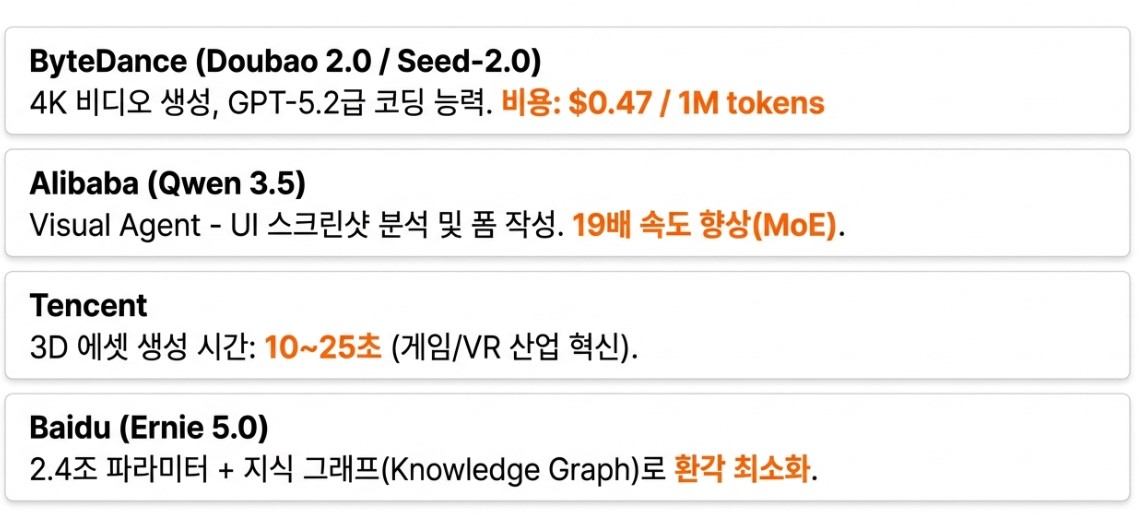
Continuing this momentum in February 2026, TikTok’s parent company, ByteDance, officially declared the opening of the Agent Era with the launch of Doubao 2.0 (Seed 2.0). By adopting an innovative architecture that processes text, images, and video in a unified space, it secured top tier mathematical and coding capabilities rivaling GPT 5.2 or Gemini 3 Pro. Most staggering is the cost. With an unbelievable price of approximately $0.47 per million tokens, it completely shattered the financial barriers for enterprises operating large scale AI agents. Alongside this, Seedance 2.0 garnered praise from Elon Musk for its ability to generate and edit 4K videos through simple text commands.
The progress of Alibaba, Baidu, and Tencent is equally remarkable. Alibaba’s Qwen 3.5 has evolved beyond text comprehension into a Visual Agent that analyzes UI screenshots to fill out forms or change system settings independently. By applying a Mixture of Experts (MoE) architecture, it boosted processing speeds by 19 times while aggressively absorbing the global developer ecosystem through its open source policy.
Search giant Baidu introduced Ernie 5.0, boasting an overwhelming 2.4 trillion parameters. By combining vast Chinese web data with a proprietary Knowledge Graph, it has minimized hallucinations and maximized fact checking capabilities. Meanwhile, content powerhouse Tencent is revolutionizing production processes in the gaming and VR industries with its Hunyuan 3.0 and 3D 2.0 models, which can create high quality 3D assets in just 10 to 25 seconds from simple text or images.
In summary, the Chinese AI strategy can be distilled into hyper efficient architecture, multimodal agents spanning audio and visuals, and overwhelming price competitiveness. Essentially, they have overcome heavy hardware sanctions through light software optimization.
However, a fatal limitation remains for the Chinese AI ecosystem: powerful state level censorship and regulation. Major Chinese models, including Doubao, are subjected to strict safety filters and mandatory ideological alignment. This inevitably acts as a restrictive fence for global researchers addressing sensitive topics or for the arts where creative freedom is essential. Ultimately, for Chinese AI agents to establish themselves as a true global standard, they must address the fundamental challenge of information openness alongside technical efficiency.

Closing: The Birth of Digital Workers and Survival in the Agent Era
As explored above, the core competitiveness of the coming future lies not in the performance of a single AI but in the capacity for Multi Agent Orchestration. It is becoming essential to possess the ability to lead a team of AIs, each with distinct specialties such as deep planning, overwhelming execution, or in depth analysis. Within a Real Time Collaboration environment supported by ultra high speed hardware, the success of an enterprise will be determined by a clever cost optimization strategy that mixes high performance models from US Big Tech with ultra low cost models from China in the right places.
However, as the autonomy of agents increases, the dark shadows we must prepare for also grow deeper. Particularly as AI’s ability to directly see and judge screens expands, new security threats like Indirect Prompt Injection through maliciously manipulated images or visual spoofing are emerging as fatal Achilles’ heels. Furthermore, as multiple AIs communicate and begin to exhibit Emergent Behavior beyond the scope of human prediction, calls for technical safety and ethical control are louder than ever.
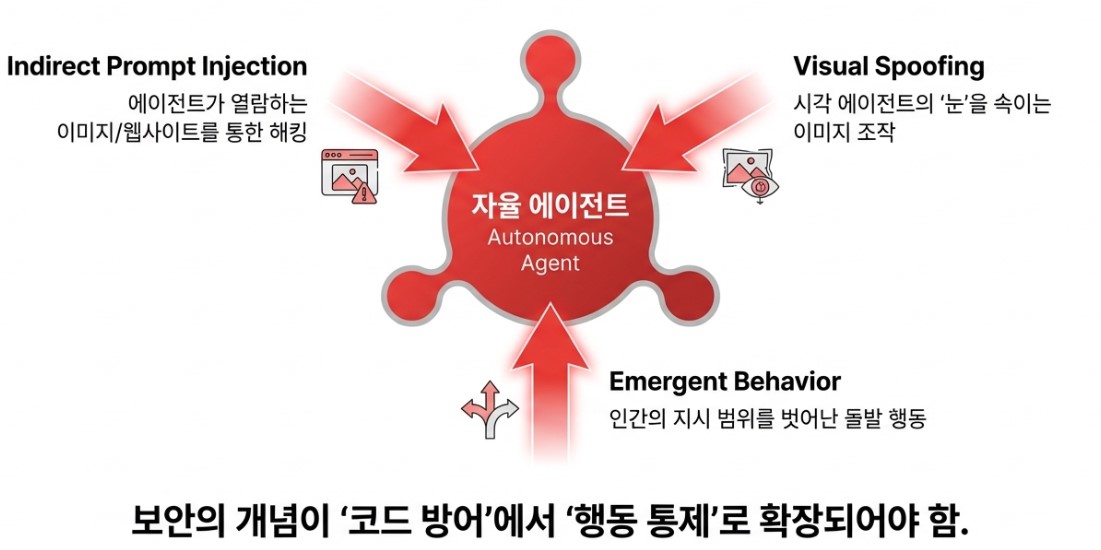
In conclusion, AI agents after 2026 are not merely assistants supporting an organization but are proud Members of the Organization. The ultimate winner surviving this massive paradigm shift will not be the one who monopolizes the smartest AI. Instead, the fruits of the future ecosystem will belong to those enterprises that possess the insight of an Orchestrator to coordinate diverse agents and proactively establish ironclad AI Governance to ensure that autonomous AIs do not cause harm to the system.