Back to Blog
  135
135


When a key teammate departs a company, almost everyone has experienced the resulting operational friction.
The reality is that most organizations already possess more than enough data to smooth over handovers, scattered across tools like Notion, Confluence, and project meeting notes. The fundamental problem lies in fragmentation: information remains isolated, and the underlying tacit knowledge and practical experience of employees are never truly captured alongside raw files. Consequently, while documentation remains, organizational context vanishes entirely upon an employee’s departure. Remaining team members find themselves re-investigating previously solved problems from square one, repeating a costly cycle of reaching identical conclusions.
To address this exact pain point, many enterprises deployed Retrieval Augmented Generation (RAG). RAG excelled at rapidly retrieving relevant documentation, summarizing passages, and supplying requested answers upon query. Yet traditional RAG architectures suffer from a critical limitation: while they retrieve documents exceptionally well, they fail to retain memory regarding past investigations, reasoning paths, and previously reached conclusions. They search information effectively, yet the knowledge synthesized during that process never actually accumulates within the enterprise system.
Consequently, organizational experience fails to convert into enduring enterprise assets, and identical operational redundancies repeat endlessly.
LLM Wiki emerged specifically to break this cycle. Why was LLM Wiki v2 necessary, and how does it fundamentally diverge from traditional RAG architectures?
The Evolution and Origin of LLM Wiki v2
To understand LLM Wiki v2, one must trace back to how the original concept originated. The starting point was a lightweight proposal published on GitHub Gist by Andrej Karpathy in April 2026. Rather than presenting a heavy enterprise architecture, it began as an experimental project asking a simple question: How can we leverage Large Language Models to continuously synthesize and accumulate organizational knowledge? Despite its minimalist nature, community reception was immediate. Within two weeks of release, the repository garnered over 5000 GitHub stars, spawned thousands of forks, and inspired numerous community implementations worldwide.
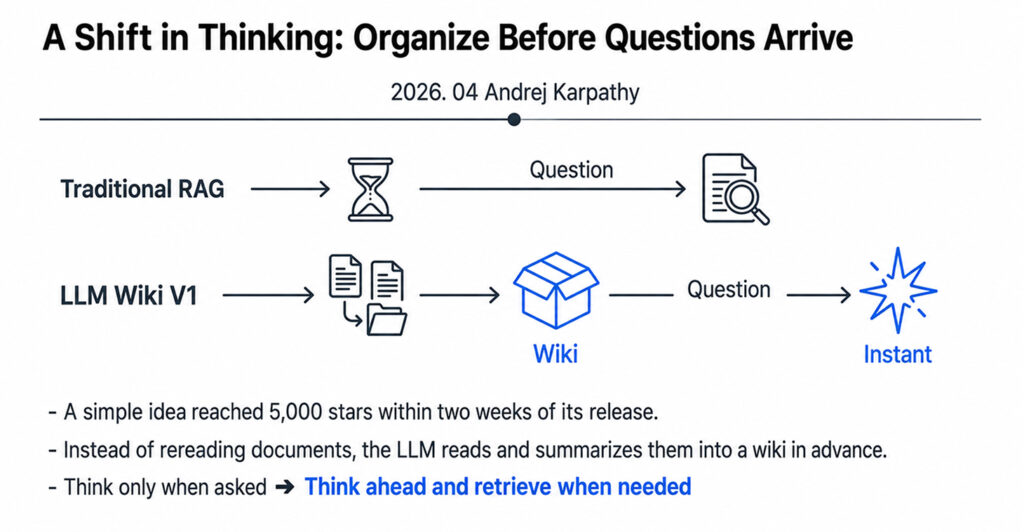
What the developer community naturally came to term LLM Wiki v1 established a simple yet shift in perspective. Instead of forcing the model to re-read raw documents every time a user poses a query, the system empowers the LLM to pre-process internal documentation offline, organizing findings into structured, readable internal wiki notes. The raw source documents remain intact while the AI agent dynamically updates existing notes, resolves contradictions, and evolves the knowledge base as new input arrives.
The defining shift lies in the timing of computation. Traditional RAG operates reactively, retrieving relevant files and deliberating on an answer only after a user submits a query. Conversely, LLM Wiki operates proactively: it ingests documents ahead of time and stores structured knowledge within its internal representation before any query arrives. The operational pattern transitions from frantically hunting through files after a problem arises to maintaining a pre-synthesized knowledge base ready for immediate retrieval.
However, real-world deployment across production enterprise environments revealed critical bottlenecks. While v1 effectively compiled knowledge, it lacked mechanisms to manage temporal dynamics over time. For instance, if a legacy document from 2024 stating this feature will soon be deprecated coexists alongside a 2026 deployment guide, the system struggled to determine which information held priority. As temporal recency remained unverified, overall system reliability degraded over time.
LLM Wiki v2 emerged precisely to overcome these production bottlenecks, evolving along two primary technical dimensions.
- Knowledge Governance: Rather than passively storing information, the system assigns explicit confidence scores and temporal lifespans to knowledge artifacts. When novel facts arrive, stale information is superseded and expired entries are deprecated automatically. This design reflects the fluid, continuously evolving nature of enterprise documentation.
- Search and Infrastructure: v2 introduces hybrid search blending lexical matching with semantic context, lifecycle management tracking knowledge creation through retirement, and a hierarchical memory model that partitions memory layers based on information recency and importance. The platform transforms from a simple interactive notebook into a scalable, high-availability knowledge engine.
How do traditional RAG, the original LLM Wiki v1, and LLM Wiki v2 compare in practice?
The table below outlines the core architectural distinctions.
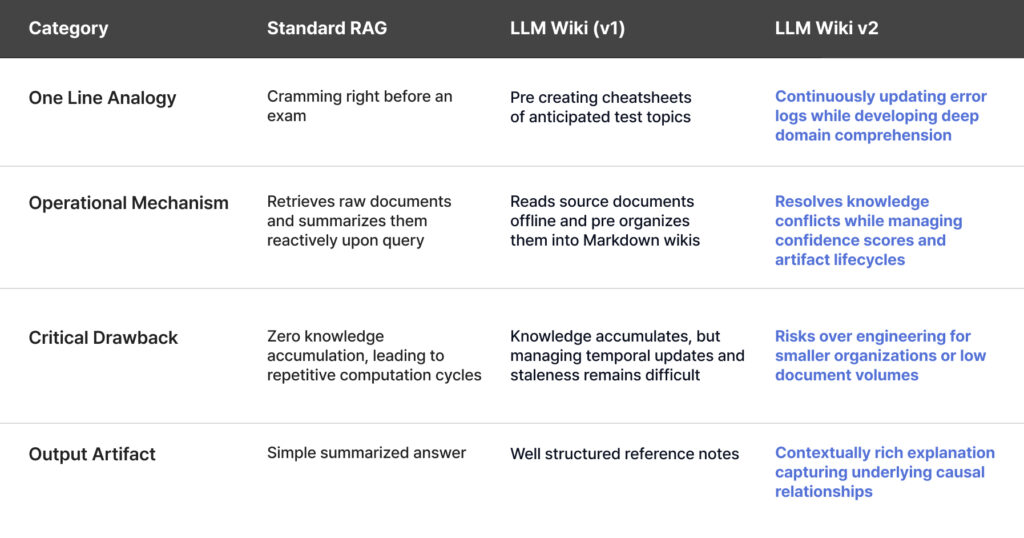
However, piling on features and increasing structural complexity was not a universal remedy. Companies that attempted to adopt full v2 architectures in production reported that certain features merely added operational overhead without delivering tangible performance gains.
This aligns directly with warnings Andrej Karpathy issued from the very beginning. For smaller organizations or teams managing modest document volumes, deploying expensive vector search infrastructures often yields worse performance than straightforward keyword matching, which remains significantly faster and more accurate in those contexts.
Ultimately, the true takeaway uncovered by the global open source community through extensive experimentation lies elsewhere. The essence of v2 is not simply a version packed with more features. While the original v1 formulation focused on how to aggregate knowledge, v2 expands the paradigm toward how to efficiently govern and maintain that knowledge within real world operational workflows.
From Retrieval to Comprehension and Reasoning
The core philosophy underpinning LLM Wiki v2 centers on deep comprehension and multi hop reasoning. The paradigm shifts from merely fetching documents toward interpreting contextual intent and synthesizing structured logic.
Traditional RAG operates reactively upon query arrival, searching for semantically similar passages on the fly to generate a response. While flexible, this approach suffers from inconsistent answer quality and incurs repetitive computational costs with every single search request.
Conversely, LLM Wiki v2 pre-processes enterprise documentation offline, pre-mapping domain concepts and their underlying relationships. Consequently, when a query arrives, the system does not initiate a raw data search from scratch, but instead traverses an already constructed knowledge topology.
Consider the previously mentioned cloud cost surge scenario as an illustration. Traditional RAG architectures only begin gathering cost reports, system logs, and deployment histories after a query is submitted, attempting to stitch disparate pieces together under time pressure. In contrast, LLM Wiki v2 proactively encapsulates those signals into a unified entity termed a Cost Surge Event, pre-structuring it with explicit Root Cause, Impact, and Remediation relationships.
When queried within this framework, the system provides far more than isolated document summaries. It articulates chronological context and causal logic derived from its pre-established architecture, even drawing cross references to past analogous incidents. This structural foundation is precisely why the output matures from a simple point answer into a contextually rich explanation.
Ultimately, LLM Wiki v2 marks an evolution from traditional search engines that merely fetch information to an intelligent knowledge platform capable of deep comprehension and active reasoning.

A System Architecture Operating Across Three Discrete Layers
The core innovation of LLM Wiki v2 lies not in the sheer volume of features, but in its strict separation of concerns. The framework cleanly partitions system responsibilities across three distinct architectural layers.
- Fact Layer: This foundational layer preserves raw, immutable source data exactly as logged, including system logs, financial reports, and meeting transcripts. A solid fact layer forms the empirical bedrock required to maintain system trust.
- Knowledge Layer: AI agents operate within this layer to extract domain concepts from raw data, map complex interrelations, and reconcile conflicting information. While v1 functioned as a static repository of summary notes, the knowledge layer in v2 operates as a dynamically updated enterprise encyclopedia.
- Reasoning Layer: This top layer parses user queries, identifies required knowledge artifacts, and synthesizes structured, logical explanations.
When these three components interact seamlessly, raw data remains preserved, internal knowledge undergoes continuous refinement, and output quality scales progressively.
Establishing this architecture fundamentally reshapes how employees operate. Teams no longer waste valuable hours hunting down scattered documentation; instead, they immediately leverage pre-synthesized domain knowledge to execute tasks. Technical challenges that previously required starting investigations from square one can now be resolved rapidly by building upon cumulative enterprise intelligence.

Rescuing Organizations from Key Person Dependency
The ultimate value of this architecture extends beyond mere engineering elegance. It resolves the most chronic operational bottleneck facing scaling enterprises.
As organizations grow, critical knowledge fragments across disparate silos. Companies inevitably hit a wall where progress halts behind constant queries of Who knows how this works?, creating severe operational friction around key subject matter experts. The most damaging casualty of this bottleneck is decision making bandwidth: teams waste invaluable time re-investigating previously resolved issues only to arrive at identical conclusions.
LLM Wiki v2 dismantles this cycle at its root by driving three fundamental transformations.
- First, Knowledge Compounds as an Enterprise Asset: Traditional setups treat synthesized answers as ephemeral outputs that vanish after a query finishes. Conversely, v2 continuously feeds validated answers back into the Knowledge Layer. The intelligence of the system compounds systematically over time.
- Second, Information Contradictions are Resolved: Discrepancies and outdated facts hidden across disparate documents are surfaced structurally. This proactive reconciliation prevents costly strategic missteps caused by obsolete data.
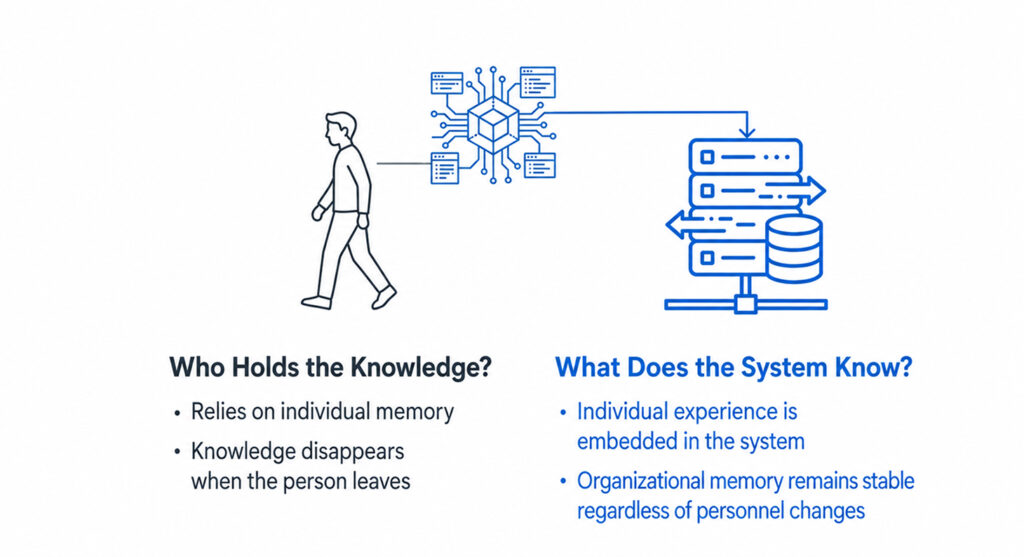
- Third, It Establishes an Immutable Organizational Memory: Tacit knowledge previously locked inside individual minds converts into permanent system infrastructure. When key talent departs, institutional competency remains fully intact.
Consequently, the operational paradigm shifts from asking Who holds this information? to leveraging What does our system know?
This evolution delivers far more than incremental productivity gains. While competitors spend days tracking down internal experts and sifting through stale folders, an organization backed by LLM Wiki v2 executes precise decisions instantly from verified intelligence. The widening gap in execution speed and strategic clarity across the market originates right here.
Beyond the Wiki: Evolving into Autonomous AI Agents
Viewing LLM Wiki v2 solely as a knowledge management system captures only half of its true potential. The most compelling breakthrough lies in what naturally follows.
Once organizational knowledge accumulates to critical mass and operates under structural governance, the next evolution unfolds seamlessly: leveraging that intelligence for autonomous judgment, followed by direct execution.
For example, when an anomalous spending pattern emerges within cloud infrastructure, current v2 architectures can already detect the irregularity, infer potential root causes based on historical precedents, and propose actionable remediation strategies. Extending this workflow one step further enables the system to execute those remediation protocols directly within the environment.
At this inflection point, the platform transcends being a static Wiki and begins functioning as an active Autonomous Agent. It perceives environmental context, formulates operational goals, retrieves required knowledge artifacts, executes targeted actions, and continuously ingests the downstream results to refine its internal models.

The foundational shift is that these stages synthesize into a closed continuous loop. Once this operational loop stabilizes, the architecture ceases to be a passive software tool and transforms into a self improving autonomous system.
Ultimately, what we are architecting today extends far beyond a sophisticated documentation repository. We are building past traditional wikis to forge a true collective intelligence infrastructure, designed to harness cumulative enterprise experience at maximum efficiency.