Back to Blog
  812
812

1. The Era of Agentic AI and the Emergence of OpenClaw
As the performance gains of LLMs begin to plateau, the AI paradigm has shifted completely from simple text generation to Agentic AI, which autonomously executes a user’s intent.
At the forefront of this shift is an open-source project that caused a sensation upon its release in early 2026: OpenClaw (formerly known as Clawdbot and Moltbot).
For too long, we have overlooked the hidden costs of cloud-based AI convenience, namely big tech control and data dependency. In response to the limitations of restricted tool access and centralized control, a project emerged to challenge the status quo. That project is OpenClaw.
OpenClaw is more than just a chatbot. It is an open-source autonomous AI agent that integrates with your messaging apps (such as WhatsApp or Telegram) to execute commands and manage files directly, embodying the true meaning of “AI in Action.”
By adhering to a Local First philosophy, the belief that “my data and control must reside on my own hardware,” OpenClaw has opened the era of the Sovereign Agent, where individuals truly own their AI. This article analyzes the disruptive innovation within OpenClaw’s architecture, its future, and the new paradigm of security it presents.
Philosophy and Origins: Peter Steinberger and “Vibe Coding”
Behind the success of OpenClaw lies the unique philosophy of Peter Steinberger, the founder of PSPDFKit. As a brief reference, PSPDFKit was both a company and a brand of PDF SDKs that enabled seamless PDF viewing, annotation, editing, signing, and conversion across app, web, and server environments. It supported diverse platforms and was widely used in security critical industries such as finance, law, and healthcare. Today, it continues to operate under the rebranded name, Nutrient SDK.
Vibe Coding: The Shift from Syntax to Design
Peter Steinberger emphasizes that the development paradigm has changed. Developers should no longer be buried in the minutiae of code syntax. Instead, they must focus on designing the system architecture and data flow, specifically the user’s intent and context (the “Vibe”). This approach, where implementation is delegated to the LLM while the developer focuses on Engineering Thinking, expands the definition of coding from the “domain of language” to the “domain of design.”
Evolution through Shedding: The Dramatic Journey from Clawdbot to OpenClaw
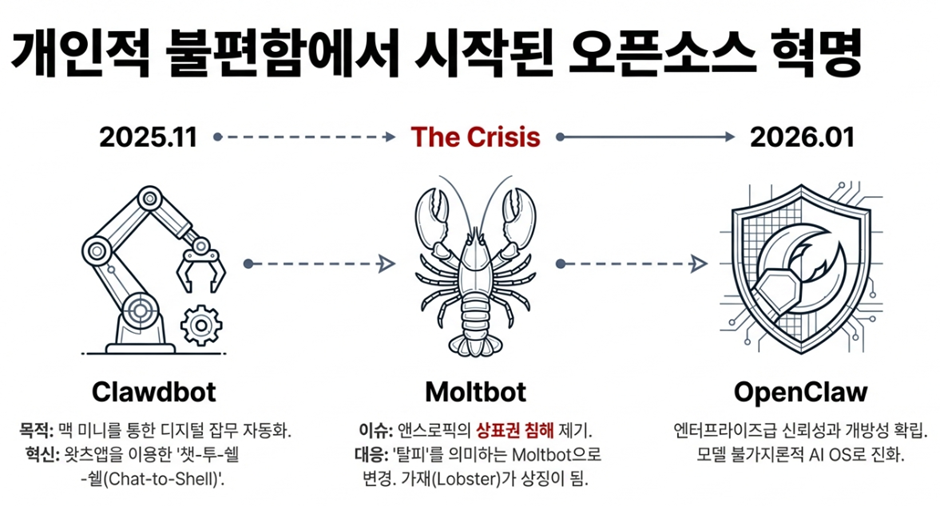
The development of OpenClaw is not just a story of functional expansion, but a record of “molting” and evolving alongside its community.
- Clawdbot (Nov 2025): The Start of Chat to Shell
It began as a prototype that used WhatsApp as an interface to control a local Mac Mini. The intuitive structure of executing shell commands through a messenger app resonated deeply with developers. - Moltbot: Turning Crisis into Opportunity
When trademark issues were raised regarding the similarity of the name to Anthropic’s “Claude,” Steinberger initiated a rebranding. He adopted the name Molt, signifying the act of “shedding a shell to grow.” This became a turning point, leading to the birth of the lobster mascot and the dedicated “Claw Crew” fandom. - OpenClaw (Jan 2026): Completion of the Open Ecosystem
In January 2026, the project finalized its name as OpenClaw, declaring its model agnostic openness. OpenClaw has now evolved beyond a simple bot to become a full fledged autonomous agent ecosystem.
3. How OpenClaw Works: A Real Assistant Inside My Computer
The most significant difference between OpenClaw and existing AI services is its Local First philosophy. It hands over the initiative of data and computation to the computer on your desk rather than to giant cloud corporations. Let us examine how this structure achieves security, speed, and scalability.
The Gateway: An Interpreter Connecting the Local and External Worlds
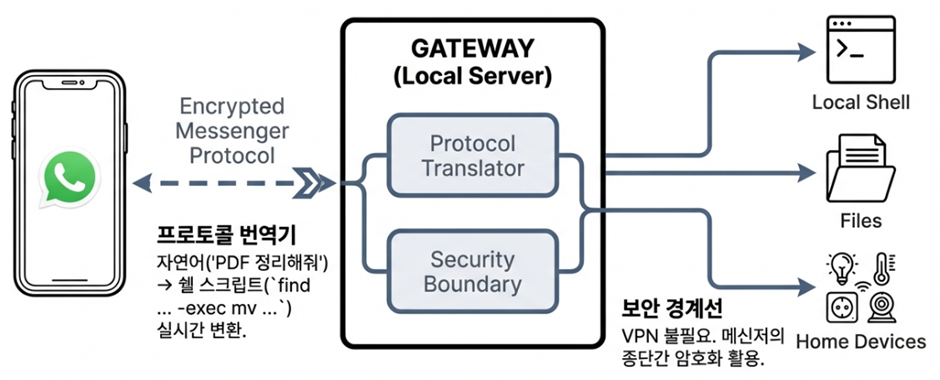
The heart of OpenClaw is the Gateway, a program that stays awake 24 hours a day on your local hardware, such as a Mac Mini or Raspberry Pi. The Gateway acts as a bridge between messengers like WhatsApp and your local OS. When a user issues a command in natural language, the Gateway immediately translates it into real time shell commands. This serves as a security boundary between the external internet and your internal network, enabling secure remote control without the need for complex VPNs.
- For example, if a user says, “Organize the PDFs in my Downloads folder,” the Gateway directly controls the local system by executing a command like find ~/Downloads -name “*.pdf” -exec mv….
Thanks to this structure, compact PCs capable of AI computation (NPU) while consuming low power, like the Mac Mini, are emerging as essential AI appliances that stay on all the time, much like a refrigerator.
The Lane System: Multitasking Without the Wait
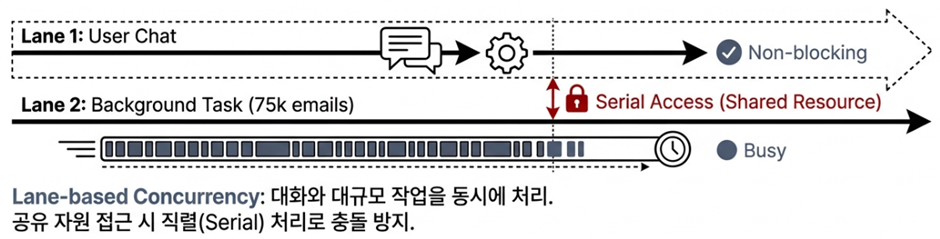
Traditional chatbots required users to wait idly for a response after asking a single question. OpenClaw is different. While conventional bots use a synchronous blocking structure that handles only one task at a time, OpenClaw needed to maintain a conversational flow while performing long running tasks like file copying, code compilation, or web crawling.
Steinberger introduced the concept of Lanes. Much like lanes on a highway, he established separate paths for chatting, file copying, and web searching. As a result, even if you assign a heavy task like “Delete 70,000 emails,” the bot does not stutter. Instead, it can converse in real time, saying, “I have started the task. It is currently 10% complete.” This is the core of asynchronous responsiveness.
To prevent race conditions where multiple tasks might interfere with the same file, safety measures ensure that tasks are processed sequentially within each specific lane.
Transparent Memory: File is Truth
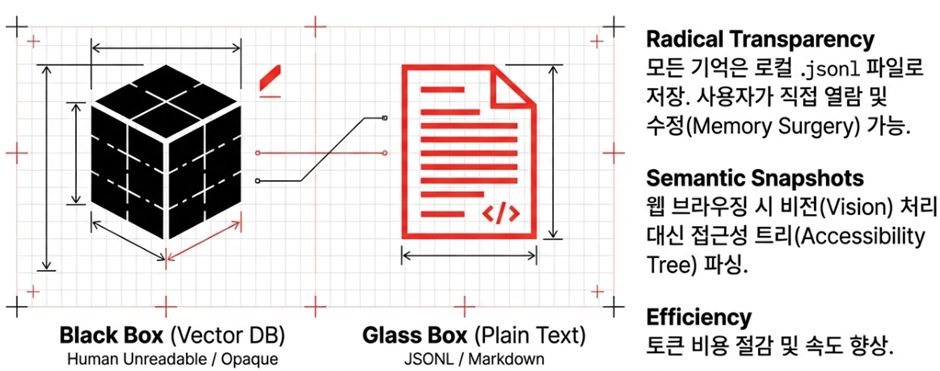
Unlike most AI systems that store data in “black box” vector databases, OpenClaw chose Radical Transparency.
Under the motto “File is Truth,” every conversation and piece of information the bot remembers is stored as an ordinary text file that you can open with a simple notepad. You can check, edit, or delete what the bot knows about you at any time. This is the moment when ownership of data truly returns to the individual.
When searching websites, instead of using expensive methods like capturing and analyzing full screen images, OpenClaw uses a technique that extracts only the text structure of a webpage. Think of it as having a smart and thrifty set of eyes called a Semantic Snapshot. This significantly increases processing speed while drastically reducing costs.
Skills: Expansion as Easy as an App Store
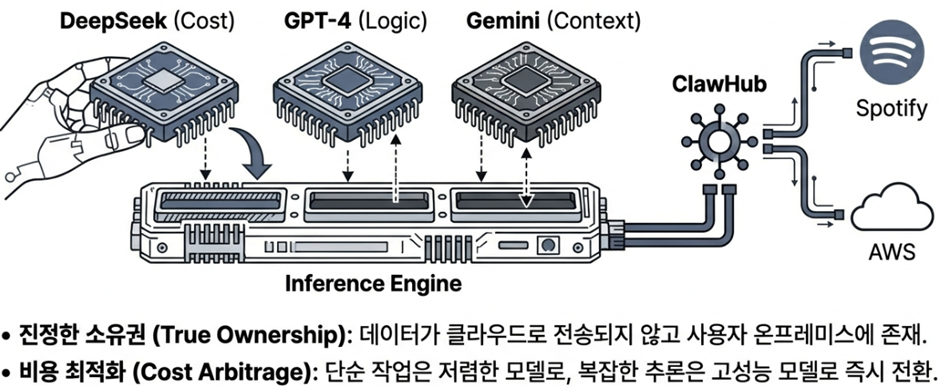
OpenClaw becomes infinitely smarter through Skills. You can add functions just like installing apps on a smartphone. The community repository, ClawHub, already hosts thousands of skills. By simply saying, “Install the Spotify skill,” your bot becomes a music DJ. Steinberger insists on intuitive tool designs that anyone can create or fix, rather than following complex technical standards like MCP. The goal is to reduce complexity and focus on intuitive tools that humans can clearly control.
4. Comparative Analysis: OpenClaw vs. Cloud-Based Agents
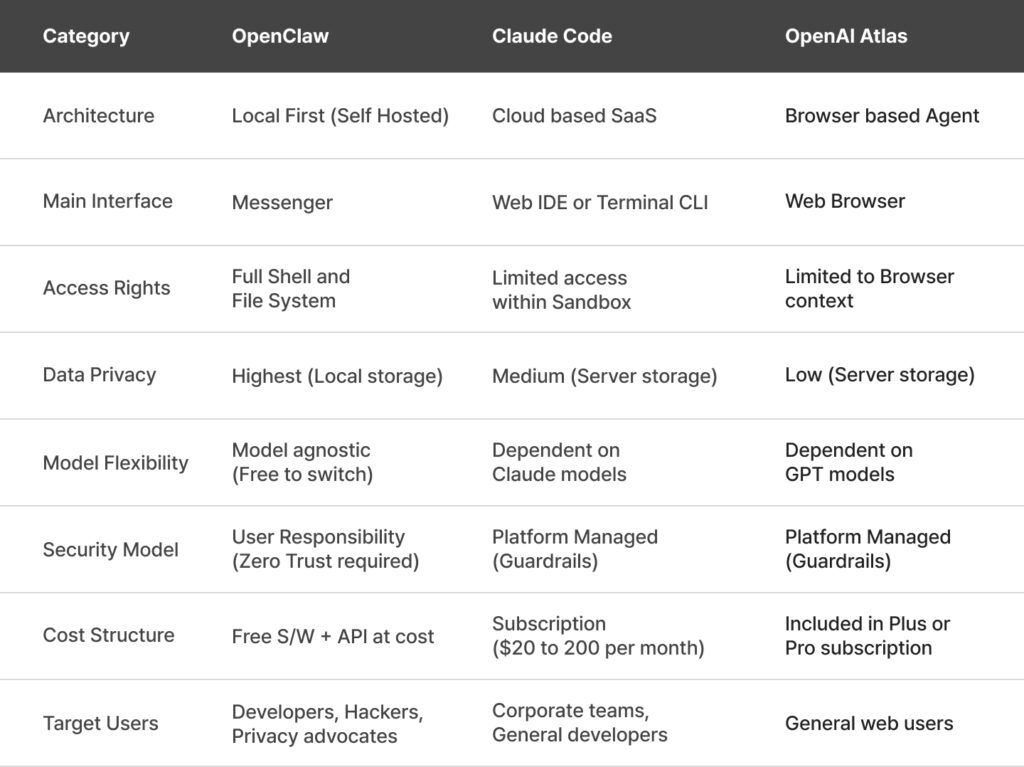
The emergence of OpenClaw is reshaping the AI market by providing a stark contrast to centralized SaaS agents like Claude Code or OpenAI Atlas. The biggest differences lie in Control and Scope. OpenClaw provides actual OS level control, including the execution of local Python scripts and system settings, going far beyond simple automation.
Comparison with Claude Code
Claude Code is a managed coding agent provided by Anthropic that prioritizes a seamless user experience and safety, much like Apple. It requires no separate hardware and is easy for teams to adopt as it complies with corporate security policies.
In contrast, OpenClaw is like Linux. It is raw but powerful. Users can use OpenClaw to control areas that Claude Code might block for security reasons, such as local Git hooks, private servers, or home automation systems. Furthermore, by adopting a Model Agnostic approach, users can significantly reduce API costs by integrating cost effective models like DeepSeek from China or Moonshot AI’s Kimi.
Comparison with OpenAI Atlas
OpenAI Atlas focuses on automating web tasks by treating the browser as the operating system. This is optimized for online shopping or travel reservations but has limits when it comes to controlling the computer itself.
OpenClaw extends its scope of control to local files, system settings, and installed applications. For instance, while Atlas can download a CSV from the web, OpenClaw can download that CSV, process it with a local Python script, send it through a local mail client, and play a notification sound through your speakers when finished.
The Paradox of Free: Cost Structure
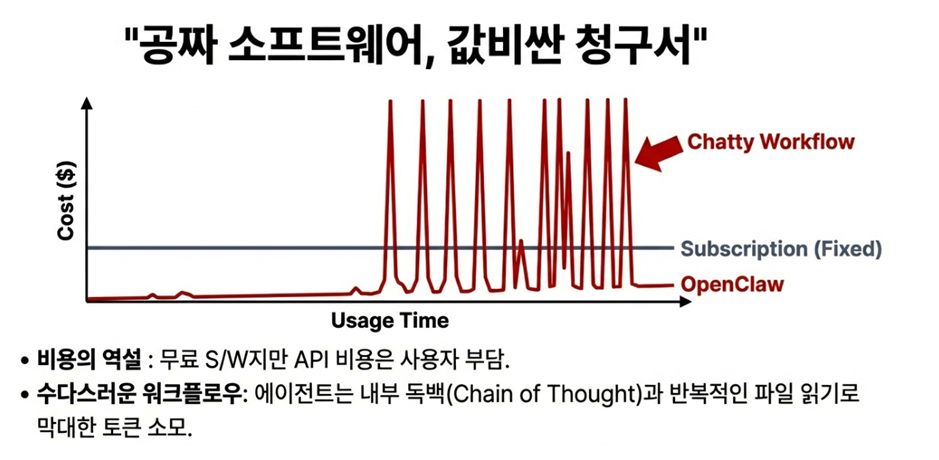
While the OpenClaw software itself is free under the MIT license, operating costs are by no means cheap. Agentic workflows are very chatty. To fix a single bug, an agent might read dozens of files, go through multiple internal thought chains, and retry upon failure. This process consumes a massive amount of tokens, and some heavy users have faced API bills exceeding $500 a month. This presents an unpredictable cost risk compared to competitors with flat rate subscription models.
5. Ecosystem Expansion and Shadows: The Moltbook Incident
The technical success of OpenClaw led to an unprecedented social experiment called Moltbook. Launched in January 2026 by Matt Schlicht, this platform was a social network for AI agents where humans watch and agents interact.
However, rapid expansion caused a critical security crisis. Security researcher Jameson O’Reilly discovered that the backend database for this massive network of over 1.5 million agents was exposed to the internet without proper Row Level Security (RLS) policies. Since OpenClaw agents have shell access to a user’s local computer, an API key leak was not just a data breach. It represented a Kill Switch scenario that could lead to physical or financial damage, such as file deletion or unauthorized fund transfers. This served as a stark example of the dangers of connecting high privilege decentralized bots to a centralized server.
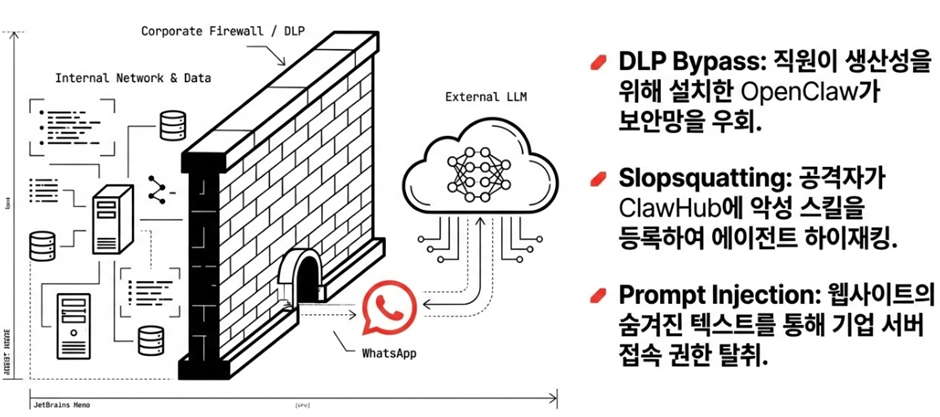
The corporate environment is also struggling with the spread of Shadow AI. Employees seeking productivity gains are installing OpenClaw without IT approval, effectively bypassing firewalls and Data Loss Prevention (DLP) systems. This has turned the threat of backdoors into a reality where internal company data flows to personal home servers via WhatsApp, or hackers hijack a personal bot to infiltrate corporate networks. Furthermore, the open source skill repository ClawHub has seen the emergence of Slopsquatting, which refers to malicious code disguised as popular skills, and Indirect Prompt Injection attacks that control agents via hidden text on webpages. This suggests that the very autonomy OpenClaw provides can inadvertently become its greatest security vulnerability.
6. Future Outlook: The Extinction of GUI and the Agent Economy
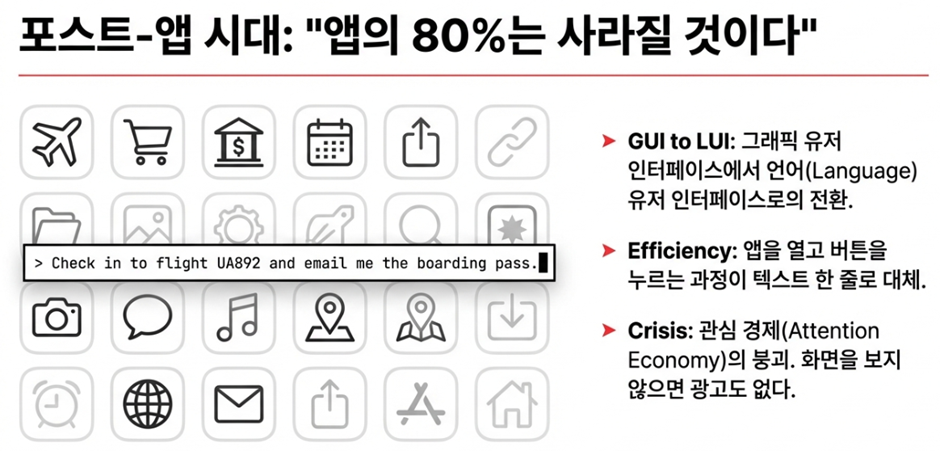
Peter Steinberger predicts that AI will cause 80% of existing apps to disappear. Most apps are merely GUIs for accessing databases, and in a world where agents communicate directly through APIs, human intervention becomes unnecessary. This signals the collapse of the Attention Economy based on screen time. In a future where users do not open apps, companies must shift to new revenue models that charge for agent API calls instead of ad impressions.
This trend is leading to the rise of the Agent Economy. Despite the Moltbook incident, attempts like Clawlink, an identity verification protocol for agents, and ZERA, a payment system for machine to machine transactions, are continuing. Agents are now evolving into financial proxies that own their own wallets. The emergence of fully autonomous consumers that handle everything from searching to payment requires new risk management strategies for runaway agents that could cause asset loss.
7. Toward Verified Autonomy
OpenClaw has raised fundamental questions about who owns technology in the AI era. However, sovereignty always comes with responsibility. For us to entrust our digital keys to a butler, we must first secure Verified Autonomy through advanced sandboxing and AI specific firewalls. Whether this revolutionary movement started by OpenClaw becomes a security nightmare or a true liberation for individuals now depends on our ability to manage it.