LaonRoad Unveils Korea’s First AI Semiconductor–Based Edge Computing System ‘AI-MEC’
Showcases Next-Generation AI Traffic Solutions at the 2025 ITS Asia-Pacific Forum
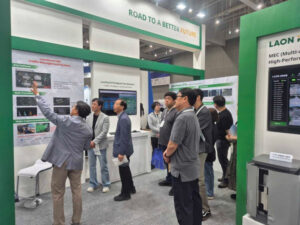
LaonRoad has unveiled AI-MEC, Korea’s first edge computing system powered by a domestically developed AI semiconductor.
LaonRoad, an AI traffic solutions subsidiary of KOSDAQ-listed LaonPeople (CEO Suk-Joong Lee), showcased AI-MEC along with next-generation AI traffic analysis technologies—including digital twins and AI agents—at the 2025 ITS Asia-Pacific Forum in Suwon.
During the event, LaonRoad introduced AI-MEC, a core component for building C-ITS (Cooperative Intelligent Transport Systems) infrastructure, drawing strong interest from global companies. AI-MEC is the first edge computing device in Korea built with a domestic AI semiconductor, capable of analyzing HD CCTV streams (four channels or more), detecting vehicles and pedestrians, and integrating with various sensors such as LiDAR, radar, and RSU devices to collect real-time traffic data.
The system has obtained official certification for 15 items under the National Police Agency’s Standard Environment Test, and demonstrated stable performance in harsh outdoor conditions—including heavy rain, dust, and extreme temperatures—during field tests at the Anyang Smart Intersection site. With its ability to provide essential V2X data for autonomous driving, AI-MEC is expected to expand into diverse traffic and urban mobility applications.
At the ITS Asia-Pacific Forum, LaonRoad presented its latest traffic solutions to around 40 domestic and international organizations, including the Korea Road Traffic Authority and Incheon Metropolitan City, and discussed collaboration with global players such as TomTom and Miovision. The company also unveiled advanced AI technologies such as the Decision Support System (DSS) for traffic operations, the Traffic Analysis System (TAS), the Traffic Management System (TMS), and a Digital Twin Network (DTN).
The digital twin platform demonstrated its ability to optimize traffic signals, reduce delays, simulate intersection performance, and automatically generate analytical reports—providing actionable insights and improving operational efficiency for municipalities. As digital twin technology enables scenario-based traffic simulations in a virtual environment, it is becoming a key tool for modernizing city traffic systems.
LaonRoad also plans to use its AI Agent–based DSS to analyze recurring and non-recurring congestion, accidents, and other traffic issues in real time using CCTV and sensor data. The system will support forecasting, automated reporting, and rapid decision-making, accelerating smart city deployments.
Kang Byung-gi, Vice President of LaonRoad, said,
“Through this event, we successfully initiated partnership discussions with leading domestic municipalities, enterprises, and major global ITS companies. We plan to localize our technology for international markets—particularly Southeast Asia and North America—and expand our smart city solution offerings.”
The 2025 ITS Asia-Pacific Forum, jointly hosted by Suwon City and Korea’s Ministry of Land, Infrastructure and Transport, welcomed more than 4,200 experts and industry leaders from 37 countries.
LaonRoad—having already deployed 550 smart intersections across Anyang, Seongnam, Hwaseong and other major Korean cities—continues to expand its footprint across the full spectrum of AI-driven traffic technologies, including AI traffic analysis, traffic management systems, digital twins, and cooperative autonomous driving infrastructure.