 Back to Blog
  0
0
 265
265

Hello, this is Samantha, Brand Manager of the HI FENN team. Samantha is also the name of the AI assistant from the film Her—and you’ll be seeing this name often in our HI FENN content. I look forward to supporting you throughout your AI journey!
🧠 What exactly is an AI Agent?
We use various software and automation tools every day to manage our work. These tools handle tasks such as inventory management, customer support, scheduling, and simple data entry.
However, existing business tools are passive. For example, a person must manually enter stock quantities and request orders in an inventory management system. While Robotic Process Automation (RPA) automates repetitive, rule-based tasks, it falls short when dealing with unexpected situations or corner cases.
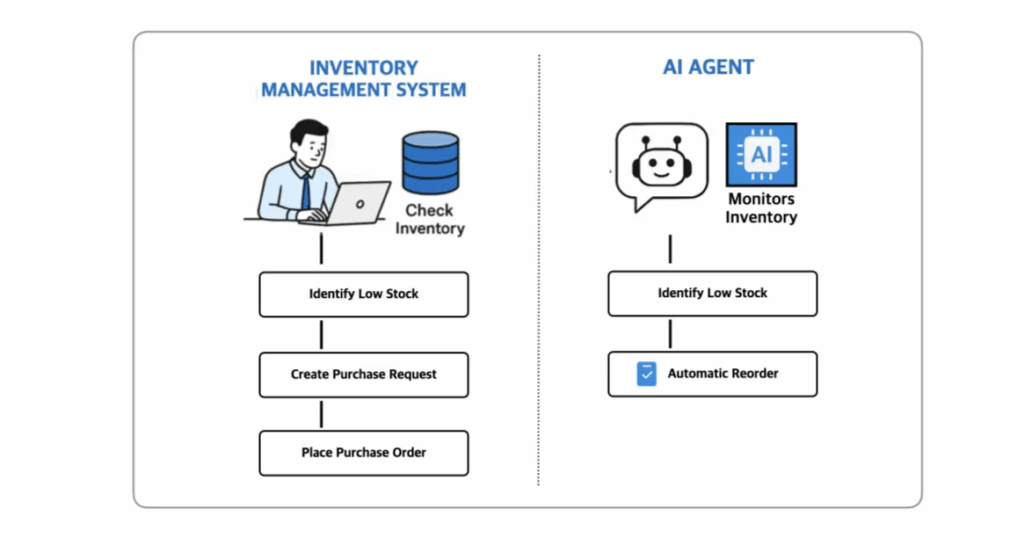
The concept of the AI Agent was proposed to overcome the limitations of these existing software and automation tools, allowing AI to perform tasks in a more complex and autonomous manner.
Simply put, an AI Agent is:
“An artificial intelligence that judges and acts on its own to achieve a given goal.”
Unlike existing work tools, an Agent does not wait for human instructions. It recognizes the situation autonomously, conducts reasoning, communicates with external data/services to perform the work, and has the advantage of handling tasks far more complex than conventional business tools.
Key Characteristics of an AI Agent
| Context Awareness | Recognizes the surrounding context on its own, beyond simple input values |
| Autonomous Reasoning | Independently plans the necessary tasks to achieve the goal, evaluating and deciding between multiple options. |
| Action Execution | Performs the work by communicating with external systems |
| Feedback Learning | Self-improves by reflecting on the results. |
An Agent works more like a teammate who can flexibly handle complex situations, moving beyond single-task automation. While existing business tools are ‘command-based,’ Agents are ‘goal-based.’
Real-World Examples of AI Agents
| Item-Tariff Code Matching | Automatic Inventory Ordering | Meeting Summarization | Automated Customer Support |
| A user inputs an item, and the Agent references internal databases and external standards to find and suggest the most appropriate code. | If a specific item’s stock drops below a threshold, the Agent automatically drafts and submits a purchase request. | Receives a meeting recording file, extracts key discussion points and to-do lists, and distributes them to the team. | Classifies customer inquiries, generates a reply, or forwards the query to the appropriate staff member. |
→ The core of an Agent is recognizing a goal and performing a series of necessary actions, not just providing a simple response.
🤔 Agent: Isn’t it Similar to a RAG LLM Chatbot?
This is a frequently asked question. However, RAG-based LLM chatbots and AI Agents are different.
What is RAG? Retrieval-Augmented Generation (RAG) is a method where, upon receiving a user’s question, it first searches an external database for relevant information and then generates an answer based on that information. Last year, many companies eagerly adopted RAG-based systems, but many were left unsatisfied.
Why Did Many Companies Feel Disappointed with RAG?
The main reasons include:
- Limitations in Information Retrieval Quality: Answer accuracy varied significantly depending on the quality and consistency of the retrieved documents.
- Lack of Agency/Action: It provided an answer but failed to perform any necessary follow-up work or execution.
- Failure to Handle Complex Requirements: It could manage simple Q&A but could not cope with complex business workflows or multi-step decision-making.
Today, the “AI Agent” is gaining the attention of many companies as an alternative to overcome these limitations.
Unlike an RAG LLM chatbot, which merely “retrieves information,” an AI Agent, which “judges and acts autonomously,” has the following characteristics:
| Feature | RAG LLM Chatbot | AI Agent |
| Basic Operation | Question Answering | Goal Setting, Context Judgment, Action Execution |
| Information Access | Pre-trained model + RAG search based | Search + Context Awareness + Action Trigger |
| Usage Pattern | Input Question → Output Answer | Set Goal → Plan Tasks → Execute Multiple Actions |
| Complexity | Relatively simple | Requires complex logic and flow design |
The goal of a RAG-based chatbot is “to find the most appropriate answer to a question.” In contrast, the goal of an AI Agent is “to autonomously plan and execute the actions needed to achieve a goal.”
For example, if a customer asks, “Analyze the recent defect rate of product A,”
- The RAG Chatbot will search for and summarize defect rate data or reports.
- The Agent will retrieve the defect rate data, request additional data if necessary, or automatically generate a corrective action plan.
The Agent does not stop at “handing over information.” It creates a “workflow that leads to action.”
🧐 If Agents are So Hot, Why Have Few Companies Adopted Them Yet?
It would not be an exaggeration to call 2025 the “Year of the AI Agent,” as every AI-related media outlet is talking about them.
Agents:
- Reduce repetitive tasks
- Increase the speed of work
- Propose a new way for humans and AI to collaborate
Yet, in reality, only a few companies have adopted them. Why?
Reason 1: Technical Complexity
Creating an AI Agent requires more than just simple modeling. It needs:
- Complex workflow design
- Integration with various systems (APIs)
- Control over data flow
- Designing the Agent’s action logic
This is far more complex than just launching an LLM. Especially for large organizations, connectivity with existing systems (ERP, MES, CRM, etc.) is essential, and this integration work is not simple.
Reason 2: Lack of Trust in Agent Outcomes
Customers often ask:
“If an Agent handles the process, will the accuracy be 100%?”
AI Agents are fast and accurate, but errors can still occur in complex exceptional situations or with incomplete inputs. However, Agents continuously improve their performance through feedback and learning. Therefore, “continuous improvement” is more critical than “perfect performance” in the initial stages of adoption.
A desirable approach is to continuously manage quality by providing feedback on the Agent’s output and setting detailed criteria, even if the Agent makes mistakes initially. Trust issues regarding Agent outcomes can be managed through the following measures:
Ways to Mitigate Anxiety:
- Operate an Agent + Human Verification Structure initially.
- (Agent proposes → Human approves → Agent finalizes the work with the approved version)
- Of course, in this case, it is crucial to clearly indicate at which stage the human approval is required.
- Provide a Confidence Score.
- The Agent displays its “level of confidence (probability)” in the result.
- Design a Fail-Safe Process.
- Include logic to switch to manual review in cases where errors are possible.
- Establish a Continuous Tuning System.
- Monitor the Agent’s results and update it periodically.
⏰ When and How Should Our Organization Start Adopting AI Agents?
Not every organization needs to adopt an Agent right away. Timing and Strategy are crucial for successful adoption.
1. When Should You Consider Adoption?
| – If you have many repetitive tasks (and need more than RPA). – If data flow is disconnected between departments. – If work processes are complex and involve many exceptions. – If you need to make data-driven decisions quickly. |
If you see these signs, it’s time to consider Agent adoption.
2. How Should You Start?
1) Select a Pilot Area
| – Start with tasks that have a narrow scope and low risk (easy to measure performance). – Examples: Inventory management, FAQ response, scheduling automation. |
2) Build a Small, but Real Agent
| – Don’t approach this as a grand ‘digital transformation project’ from the start—that often leads to failure. – Begin with a small Agent that performs actual work. |
3) Prepare for Integration with Existing Systems
| – Verify the feasibility of API integration with key systems like Groupware, ERP, and MES. – Organize the schema of the small, but real, business data. |
4) Set and Measure KPIs (* KPI: Key Performance indicator)
| – Compare performance before and after the Agent platform introduction. |
5) Phased Expansion
| – Gradually expand the scope of application based on initial success. |
3. Points to Note When Building an Agent
- Beware of Scope Creep
- Don’t try to assign too many tasks from the beginning.
- Don’t try to assign too many tasks from the beginning.
- Collaboration between Business and IT
- The business team clarifies the requirements, and IT supports system integration.
- The business team clarifies the requirements, and IT supports system integration.
- Adopt a Phased Trust Enhancement Model
- Start in verification mode → gradually transition to a fully autonomous mode.
Conclusion
The AI Agent is not simply a ‘new technology’ but a tool that innovates an organization’s work methods. By approaching it strategically, you can secure a competitive advantage faster than others. HI FENN supports the entire process, from designing and building an AI Agent platform tailored to your organization’s needs to continuous improvement.
If you have any further questions, please submit them through our inquiry form. We will return with our next article.
HI FENN Team
Samantha
Comments
Posts that violate our policies may be removed without prior notice.