 Back to Blog
  0
0
 283
283
Hello! This is Samantha from the HI FENN team.
Have you ever worked with data and thought, “Do I need to write an SQL query for this? Should I ask the IT team?” HI FENN is the platform that can eliminate such worries. Anyone can easily create an AI Agent that searches databases (DBs) using natural language and automates tasks as desired. Today, I’ll kindly explain how this fantastic feature works, what it can do, and the changes it brings to our daily work!
How Does Natural Language DB Search Work? 🤔
Natural Language DB Search allows you to extract data using your everyday speaking style. By leveraging this feature, you can automate various tasks and make faster data-driven decisions. Here is a simple breakdown of how it works within the HI FENN platform:
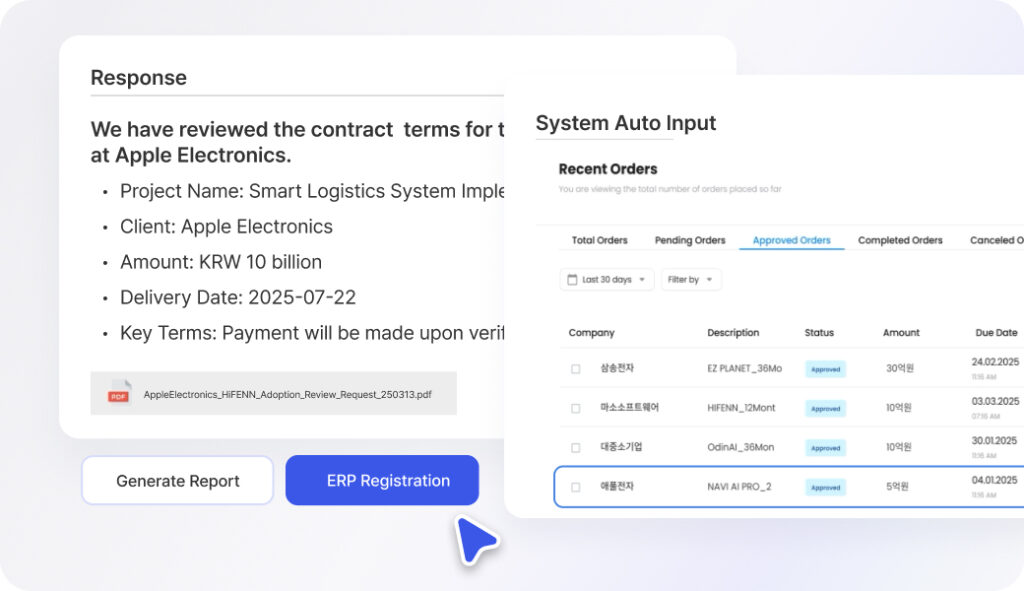
- DB Connection: The user connects their DB (CRM, MES, ERP, etc.) to the platform using the Agent Flow Studio. This process is completed with a few clicks through an intuitive UI.
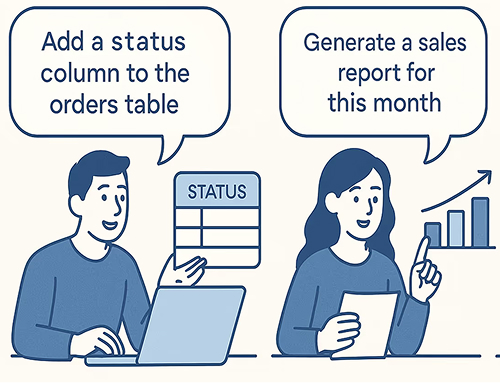
- Natural Language Request: The user requests the desired information in natural language. For example, they might say, “Find the top 2 sales lead data points and investigate those companies via a web search.”
- Query Conversion: The AI Agent analyzes the natural language and converts it into a DB query. For example, the request above is first converted into an SQL query like SELECT * FROM leads ORDER BY created_at DESC LIMIT 2;. It then optimizes the query based on the DB schema information to understand the table structure.
- Data Retrieval and External Integration: Based on the retrieved data, the Agent performs additional tasks (e.g., web search). In the example above, it searches the web for the company names from the lead data to gather company information.
- Result Organization and Delivery: The final result is organized and provided in an easy-to-understand format for the user, or it is delivered as a notification via a messenger (KakaoTalk, Slack, etc.).
All this can be done without coding, in just a few minutes! Isn’t that convenient? 😎
What Can Be Achieved with Natural Language DB Search?✨
Leveraging Natural Language DB Search allows you to automate various tasks and make data-driven decisions quickly. Here are some use cases:
1. CRM DB Integration: Optimizing Sales Processes
- Scenario: “Find leads with delayed follow-up in the last 7 days and send a KakaoTalk notification to the assigned representative.”
- Implementation: Connect the CRM DB and set up the Agent to retrieve delayed leads using natural language. Automatically send notifications to the representatives of the retrieved leads.
- Effect: Automated lead follow-up increases conversion rates by 20%.
2. MES DB Integration: Manufacturing Process Monitoring
- Scenario: “Find equipment data where abnormal patterns were detected in the last 24 hours and report it to the team lead via Slack.”
- Implementation: Set up the Agent to detect abnormal patterns (e.g., temperature outliers) from the MES DB. Immediately send an alert when abnormal data occurs.
- Effect: 15% reduction in downtime for component manufacturers.
3. ERP DB Integration: Inventory and Supply Chain Management
- Scenario: “Check items with less than 10 units in stock and automatically send a purchase request email to the supplier.”
- Implementation: Retrieve inventory data from the ERP DB, find items that meet the condition, and request a purchase via email.
- Effect: 58% reduction in out-of-stock incidents for e-commerce companies.
4. HR DB Integration: Automating Personnel Management
- Scenario: “Find employees who have exceeded 40 working hours and report them to the HR team’s Slack channel.”
- Implementation: Retrieve working hour data from the HR DB and automatically report employees who have worked overtime.
- Effect: 30% reduction in HR management time for IT companies.
5. Customer Support DB Integration: Improving Customer Experience
- Scenario: “Search the customer inquiry DB for queries containing the keyword ‘refund’ and suggest a solution by searching the web.”
- Implementation: Search the customer inquiry DB for a specific keyword and suggest the optimal solution through a web search.
- Effect: 40% reduction in customer response time for startups.
6. Marketing DB Integration: Analyzing Campaign Performance
- Scenario: “Analyze marketing campaign data from the last 3 months and find the top 5 campaigns by click-through rate.”
- Implementation: Retrieve campaign data from the Marketing DB, analyze performance metrics, and extract the top campaigns.
- Effect: 25% improvement in marketing campaign ROI.
7. Finance DB Integration: Risk Management
- Scenario: “Find customers with payment delays in the last quarter and investigate their financial status via a web search.”
- Implementation: Retrieve payment data from the Finance DB and collect the customer’s financial information through a web search.
- Example: 30% reduction in delinquency risk and improved recovery rates.
How Much Easier Will the Actual Work Become? 😊
Natural Language DB Search dramatically simplifies the work of department personnel:
- Time Savings: Obtain the desired data in seconds without writing complex SQL queries or requesting help from the IT department.
- Customized Workflows: Optimize workflows by creating AI Agents tailored to the unique requirements of each department.
- Real-time Response: Data retrieval and notifications happen in real-time, allowing for rapid detection and response to issues.
- Non-Developer Friendly: Employees without coding knowledge can easily create Agents, reducing the burden on the IT department.
For instance, a marketing manager who created a “Campaign Performance Analysis” Agent saw a weekly report task that took 3 hours drop to just 5 minutes! Imagine the time savings if this efficiency spread across the entire team.
What Value Does It Bring? 💸
Natural Language DB Search generates immense value relative to the investment. Here is a summary of how it creates ROI:
- Cost Reduction: There is no need for hiring developers or incurring costs for implementing external solutions. Department personnel can build the Agent directly, resulting in low initial investment costs.
- Productivity Improvement: Manual data retrieval, reporting, and notification tasks are automated, increasing the volume of work that one employee can handle.
- Risk Mitigation: Problems like stock shortages, missed sales opportunities, and equipment failures are detected early, reducing financial losses.
- Improved Customer Experience: Fast and accurate customer responses boost customer loyalty, leading to long-term revenue growth.
Example Cases:
- A manufacturing company built an equipment monitoring Agent using its MES DB, saving 400 million KRW (approx. $300,000 USD) annually in downtime costs.
- A marketing startup used its CRM DB to automate lead follow-ups, resulting in an 18% increase in sales.
In Which Companies and How Can It Be Applied?🏢
Natural Language DB Search excels in companies of any industry and size:
- Small and Medium-sized Enterprises (SMEs): SMEs with limited IT staff can implement data-driven decision-making at a low cost.
- Example: A retailer connects its inventory DB to prevent stockouts.
- Example: A retailer connects its inventory DB to prevent stockouts.
- Large Enterprises: Large companies with complex workflows can maximize efficiency by creating customized Agents for each department.
- Example: A global manufacturer manages quality across worldwide factories using its MES DB.
- Example: A global manufacturer manages quality across worldwide factories using its MES DB.
- Startups: Startups where rapid execution is crucial can save resources by automating core tasks like marketing and customer support.
- Example: A FinTech startup manages risk using its financial DB.
- Example: A FinTech startup manages risk using its financial DB.
One Person Starts It, and Everyone Uses It! 🚀
The real appeal of the Agent Flow Studio is how an Agent created by one person can spread throughout the organization:
- Sharing within the Team: Team members can use the exact “stock shortage alert” Agent created by one employee. Sharing is easy by saving and sharing the template.
- Expansion to Other Departments: The Marketing team’s “Campaign Analysis” Agent can be slightly modified by the Sales team and utilized as a “Lead Analysis Agent.” Modifying the template is simple, requiring only a few clicks and inputs.
- Company-wide Adoption: As success stories accumulate, various Agents can be adopted across the company to build data-driven workflows in every department. One company started with a single employee’s “Customer Inquiry Analysis” Agent and, within six months, was running 50 Agents across 10 departments.
Conclusion 🌟
HI FENN’s Natural Language DB Search feature is changing the paradigm of data utilization. If anyone can search a DB, integrate with external tools, and automate tasks without complex technical knowledge, the organization can move faster and smarter. The Agent Flow Studio is the tool that enables this transformation, realizing the democratization of data-driven decision-making.
If your organization wants to utilize data more easily, start with HI FENN and the Agent Flow Studio today. One person’s idea can revolutionize the entire organization!
HI FENN Team Samantha




Comments
Posts that violate our policies may be removed without prior notice.