Back to Blog
  0
0
 266
266

The Fatal Limitations of Conventional Intelligent CCTV
“Intelligent in name, often incompetent in practice.”
Have previous intelligent CCTVs truly been intelligent? The answer is half right and half wrong. In reality, the technological advancement of existing intelligent video surveillance systems was focused on object recognition using deep learning detection. Consequently, they were effectively only ‘half-intelligent surveillance.’ They could detect objects like people, vehicles, or fire, but they were unable to understand why the scene was important or what was happening.
“Intelligent in name, often incompetent in practice.”
The phrase “CCTV detects a fallen person” sounds plausible, but a different story unfolds in the field.
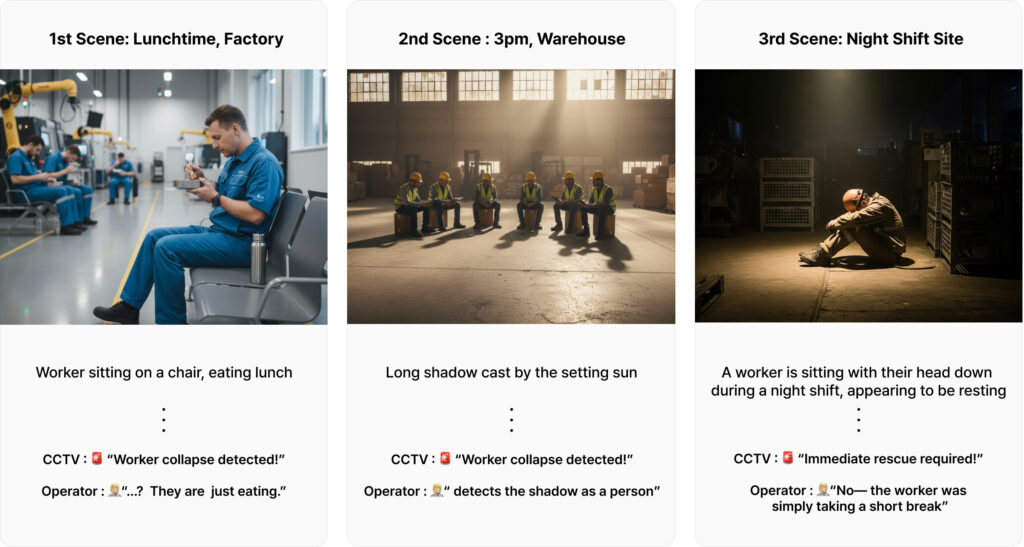
In reality, these systems frequently misinterpret a seated person as having fallen, or mistake shadows and background elements for people. What happens when this situation repeats? Control room operators, who initially rushed to the scene in alarm, eventually dismiss it with, “Oh, it’s that false alarm again…” The real problem lies beyond: they might overlook an actual danger, thinking, “It’s probably just another false alarm.”
‘Seeing the Object, But Not Knowing the Situation’
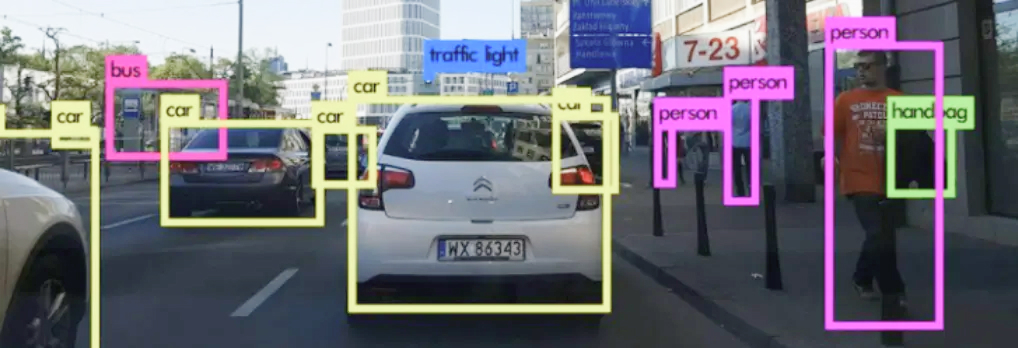
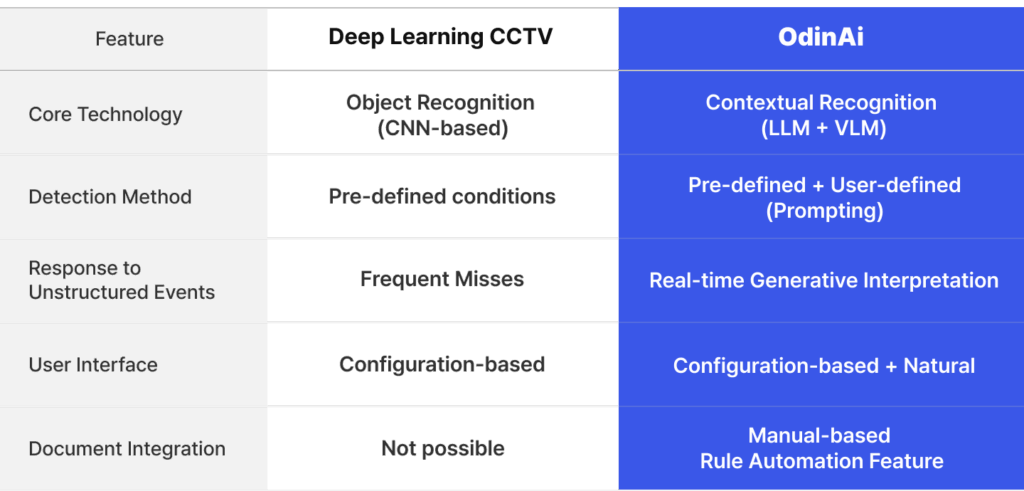
Why do these issues persist? It is due to the fundamental limitations of the CNN-based deep learning models, like YOLO and SSD, used by existing CCTV analysis systems.
- Frequent False Positives/Misses
– Object recognition rate drops sharply in dark or complex backgrounds.
– Accuracy varies significantly depending on changing environmental conditions (dawn, dusk, night glare, rain, fog, etc.). - Recognizing Only the Static Presence of an Object
– Only identifies the existence of an object (“There is a person/There is no person”)
– Cannot analyze what the person is doing or their intent behind the action - Reliance on Pre-defined Rules
– Accurate judgment is only possible within pre-determined conditions
– Lack of responsiveness to new patterns or exceptional situations
Moving Beyond Simply ‘Seeing’ to a System That ‘Understands the Situation’
So, what is the solution?
We need a surveillance system that doesn’t stop at simply recognizing objects in front of it but understands the context of the situation.
This is where Odin AI comes in.
Odin AI goes beyond merely distinguishing “person present/absent” to interpret the relationships between objects, the context of the scene, and the intent of the actions.
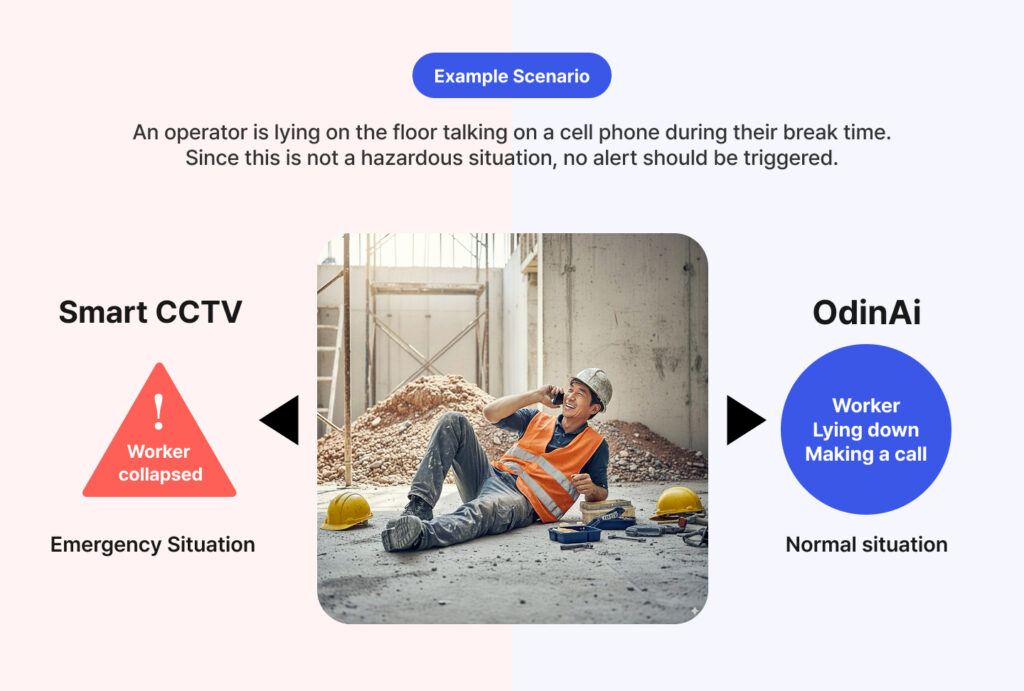
For example, suppose a worker is lying on the floor. A conventional system would unconditionally recognize this as “fall down” and issue an alert. However, Odin AI considers the surrounding context:
- Is the worker holding a cell phone and talking? → Interpreted as “Resting.”
- Conversely, are surrounding risk factors detected? → Judged as “Accident Occurred.”
Odin AI: Setting a New Standard for Video Surveillance
Odin AI is a Generative AI-based video surveillance system that overcomes the structural limitations of existing deep learning-based intelligent CCTVs. It is a next-level AI surveillance system that goes beyond simple object recognition to understand and even explain the situation.
- Contextual Understanding: Interpretation of the scene’s entire meaning, not just simple coordinate comparison.
- Action Recognition: Identification of not only objects but also actions and intent
- Minimizing False Positives/Misses: Reduces unnecessary alerts and responds faster to real dangers.
Odin AI’s Technical Structure: The Fusion of Generative Multimodal AI
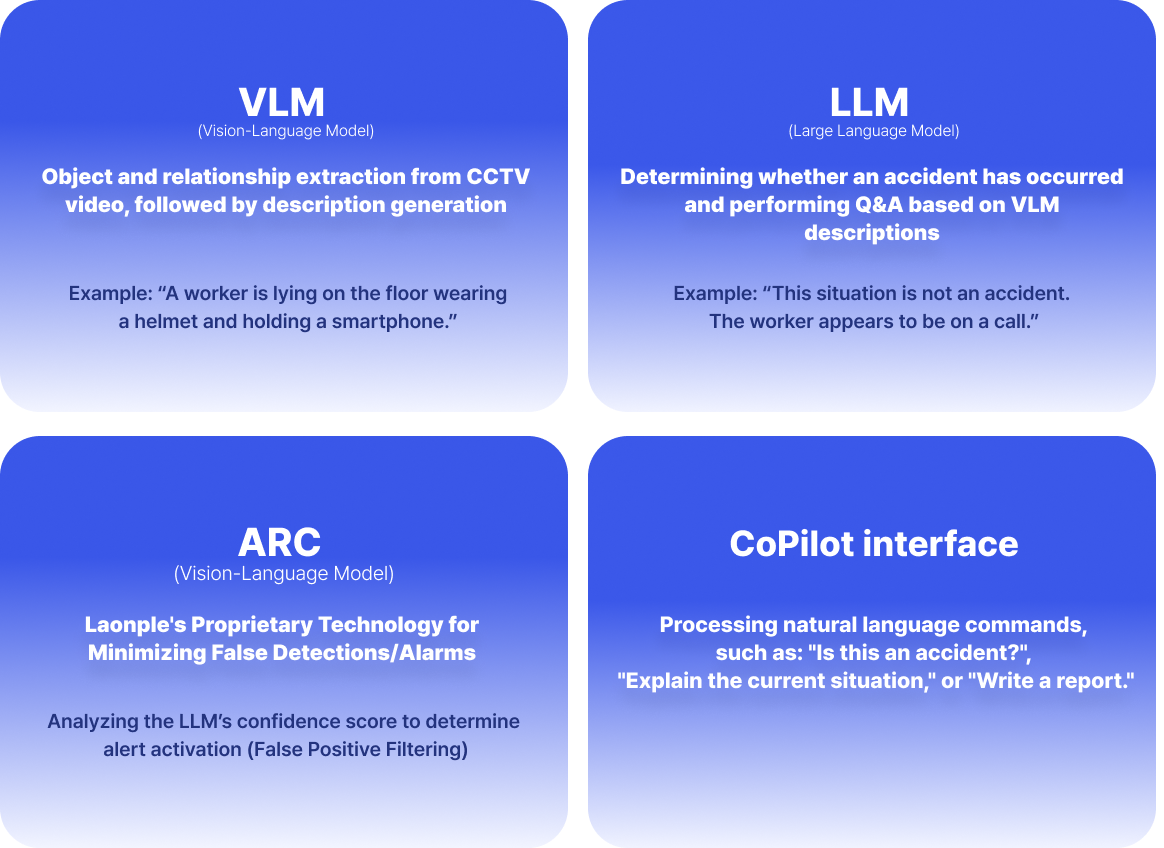
ODIN AI is designed with a Generative Multimodal AI structure capable of processing video, text, and natural language commands together. By combining LLM (Large Language Model) and VLM (Vision Language Model), it overcomes the limitations of conventional deep learning methods and realizes surveillance that understands the relationships between objects and the context of the situation within the video.
Key Differences from Conventional Intelligent CCTV
Conclusion
As we’ve seen, conventional intelligent CCTVs had a clear limitation: they focused on object recognition and failed to understand context. Odin AI addresses this structural limitation, presenting a new approach to interpreting and judging the situation within video footage.
Odin AI will continue to demonstrate new possibilities through ongoing technological development and field application. Please look forward to our next update!