Back to Blog
  836
836
In the AI industry today, the phrase “the world changes while you sleep” has never felt more literal. With technology cycles being so incredibly short, it’s become common to see yesterday’s cutting-edge tech become obsolete in just a matter of months. In this fast-paced environment, AI companies are locked in a relentless race, barely catching their breath.
Amidst this fierce current, Laon People constantly asks itself one fundamental question to ensure not just survival, but meaningful growth: “As an AI service provider, what can we truly excel at?”
To find that answer, we have spent the past few years stepping away from the flashy “arms race” of pure technology. Instead, we quietly immersed ourselves in the industrial field. Our focus wasn’t just on boosting model performance, but on creating “Field-Ready AI”—solutions that operate flawlessly in the most complex real-world environments. It has been a season of sincerity: accumulating on-site data, refining our solutions, and strengthening our internal foundations.
We believe that 2026 will be the year we prove our honed technical potential through tangible results. So, what kind of future is Laon People painting, and how have we prepared for it?
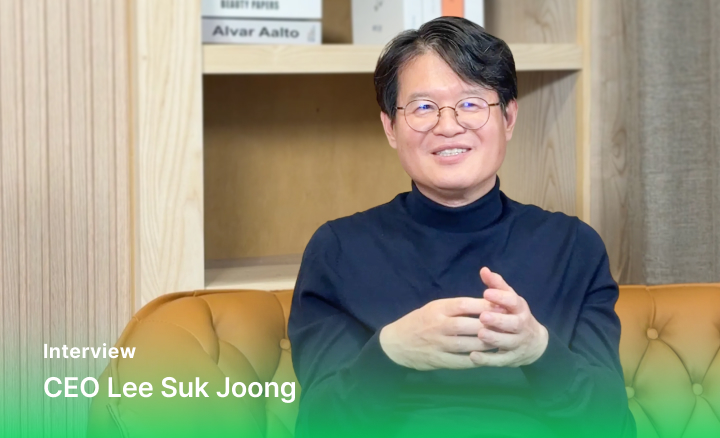
In this interview, we speak directly with CEO Suk-joong Lee about our journey so far and our plans for the future. From technical strategies to his honest reflections as a leader, we invite you to discover the story of Laon People.
The Shift in the 2025 AI Market: A Leap of Opportunity
Q: 2025 was the year AI became truly integrated into our daily lives. From your perspective, what has been the most significant change in the AI market this year, and how do you foresee future trends?
I believe we can look at this year’s changes from three main perspectives. To put it simply, the overall current of the market seems to be moving in a direction that is highly favorable for Laon People.
First and foremost, the “monopoly” once held by OpenAI in the LLM market has shifted toward performance parity. In other words, the performance gap between major LLM models has narrowed significantly. For AI service providers like us, this means we now have a much broader range of choices, allowing us to select the most optimal model based on the specific characteristics of our solutions.
In particular, the recent emergence of ‘DeepSeek-V3.2’ sent shockwaves through the market. By utilizing DSA (DeepSeek Sparse Attention) technology, they succeeded in maintaining high performance on par with existing LLMs while drastically reducing computational requirements and lowering token costs.
This technological trend is likely to put significant pressure on global Big Tech firms, potentially triggering a price war in LLM services. For companies like Laon People that develop AI applications, this environment allows us to reduce our overhead. Ultimately, it creates the perfect conditions for us to provide our services to customers at far more competitive and reasonable prices than ever before.
Q: The expanding choice of models and the emergence of cost-cutting technologies are certainly positive developments for AI service providers. What is the second change you are paying attention to?
The second point is that the “Multi-modal” era has finally begun to penetrate deep into industrial sites. To be fair, multi-modal technology itself has been around for two or three years and has been a constant buzzword in the industry. However, this year was different—it was the year we started to feel a tangible surge in actual demand from the field. We are seeing a perfect alignment between technological readiness and market necessity.
Predicting this shift, Laon People has long been refining our field-oriented multi-modal solutions. Our generative AI monitoring solution, “Odin AI,” and our AI platform, “EZ PLANET,” are the primary examples of this effort. We expect these solutions to integrate video and various sensor data across diverse industrial sites, diagnosing process anomalies from multiple angles and ultimately completing a truly intelligent management environment.
Q: It is fascinating to hear how your technical readiness is aligning with market timing. What is the final market trend you are keeping an eye on?
The final shift worth noting is the government’s aggressive support for AI Transformation (AX). We are seeing a continuous expansion of budgets for “Proof of Concept” (PoC) and implementation projects that apply AI to actual industrial sites, moving well beyond simple R&D grants. This signifies an increase in business opportunities where technology directly translates into tangible revenue.
Laon People identified this policy direction early on and moved swiftly. As a result, we’ve achieved significant milestones by being selected as a partner for various AX support projects since last year, and we are now on the verge of full-scale execution.
I believe the results of these national projects, which will become visible starting next year, will serve as powerful references that validate our technical prowess. Moving forward, we plan to use this momentum as a springboard to expand our business across both the public and private sectors.
Bridging the Gap: Laon People’s Philosophy
Q: As you mentioned, while field demand for AI has risen noticeably this year, some still say that the journey to an actual contract or implementation remains difficult. Why do you think the actual pace of transformation feels slow compared to the high level of market interest?
Many people assume that AI adoption is delayed because the technology’s performance falls short of expectations. However, the barriers we encounter in the field are much more multi-dimensional. Implementing AI within a company isn’t as simple as installing a new piece of software; it’s a massive transformation that involves changing long-standing work habits, restructuring data flows, and sometimes even reorganizing the entire company.
To manage this level of change, you need more than just the will of top management—you need concrete, practical guides that convince the actual field staff, and that is where the difficulty lies.
Two realistic issues, in particular, tend to hold things back. The first is the “absence of meticulous consulting.” Often, C-level executives decide to adopt AI because of its reputation, but they skip the professional design phase that answers the workers’ questions: “How exactly will this change our specific process, and how will it help my daily workload?”
The second is “management risk.” Since AI is a probability-based technology, it isn’t 100% perfect. Hallucinations—where the AI gives plausible but incorrect answers—are a prime example. In a manufacturing environment, even a 1% error can lead to a critical accident. Because there is a lack of “field-adjacent solutions” designed to manage these risks, many companies find it difficult to make that final leap.
Q: Then the key must be how to create solutions that can be used reliably in the field despite AI not being perfect. How is Laon People solving this challenge?
I find the answer in the history of aviation. When the Wright brothers built their first airplane in 1903, most people were obsessed with engine power. However, the Wright brothers achieved success by focusing on lift and control techniques. They proved that even if the engine performance is somewhat lacking, you can still fly as long as you have the “navigation skills” to manage the aircraft effectively.
Today’s Large Language Models (LLMs) are much the same. The models themselves are like “engines” that aren’t yet perfect, carrying inherent flaws like hallucinations—where they occasionally produce nonsensical answers. Instead of simply waiting for a better engine to come along, we are pouring our resources into the “navigation skills” to control these engines perfectly: what we call “AI Agent Engineering.”
Our agents do not simply relay the model’s output. Instead, they create their own task plans, “cross-verify” errors, and “supplement” missing information independently. We are bridging the gaps of model imperfection with the sophisticated navigation of our agent technology. Based on this, we are demonstrating to those hesitant about AI adoption that stable operations are indeed possible. We turn customer anxiety into trust by compensating for model limitations through a robust technical system.
Q: So the key isn’t necessarily clinging to the perfection of the technology itself, but rather how to manage and control that technology to fit the field. If so, what is the ultimate vision for Laon People? I imagine it’s more than just being a “company that builds good technology.”
Laon People aims to be more than just a provider selling AI solutions; we strive to be a “Solution Provider” that understands the language of the field and redesigns business structures. We have vast real-world experience gained from countless industrial sites, starting with our roots in vision inspection. Because of this, we understand better than anyone what the field staff fear and what specific metrics management teams are looking for.
Our competitive edge comes from prioritizing “on-site adoption” rather than the flashiness of the technology. No matter how advanced a technology is, it is meaningless if it is rejected by the people on the ground. Therefore, we focus on identifying the “sweet spot” where we can maximize the utility of AI while minimizing disruption to the existing organization through meticulous consulting.
Proving Superiority Through Technology
Q: So, rather than just selling technology, you aim to be a “Problem Solver” for the field. How does this philosophy manifest in your actual solutions? I’m curious about Laon People’s core products and the strategies behind them.
The core of our differentiation can be summarized as the “Organic integration of our strengths in vision technology and AI agents.” Let me walk you through our strategies for each major product line.
First, our AI Agent solution, ‘Hi FENN.’ This is built on our powerful foundational technology in the vision sector. Its ‘Deep Scan’ capability—which understands blueprints and complex documents with extreme precision—is truly unparalleled. Moving forward, Hi FENN will be enhanced into a multi-agent system by integrating an ‘Orchestration Agent’ that can autonomously prioritize and coordinate tasks between different agents. Currently, our primary focus is on ensuring a highly intuitive user experience and affordable pricing to remove any barriers for customers looking to adopt it.
Second is ‘Odin AI,’ the first in Korea to introduce generative AI to the monitoring and surveillance sector. Over the past year, we have strengthened its foundation by accumulating a vast amount of real-world feedback. The upcoming model will present a completely new level of surveillance, where generative monitoring and AI agents are organically connected. I believe the convenience and ease of use this provides will be on a different level compared to any other product on the market.
Finally, our integrated platform, ‘EZ PLANET,’ is set for a major transformation with the integration of multi-modal capabilities next year. Once multi-modal technology is implemented, AI will be able to comprehensively understand sensory data—including images, video, and sound—going far beyond simple numbers or text. This will allow the platform to be applied to a much broader range of complex and diverse industrial environments.
2026: The Strategic Leap of Laon People
Q: I can clearly sense a winning strategy centered around your core products. What is the specific technical roadmap and business plan that Laon People envisions for the near future?
Moving forward, we will continue the technical advancement of each individual solution. At the same time, we plan to focus on integrating our three core products—Odin, Hi FENN, and EZ PLANET—to create powerful synergies. Through this, we aim to build a “high-maturity service” that surpasses existing solutions, providing our customers with an unprecedented level of convenience.
This year has been a major inflection point for Laon People from a business perspective. We have been steadily undergoing a “pivoting” process, evolving from a company specialized in vision technology into a comprehensive AI software company. In the process, we have gained invaluable experience in winning the hearts of our customers and expanding our market presence. In 2026, we plan to leverage this precious experience to aggressively pursue customer acquisition and market expansion.
Q: It sounds like 2026 will be another year of running at full speed. As a leader navigating such rapid change, what is the most realistic concern you weigh on your mind?
To be honest, I have many concerns. In the AI field, new research papers are published and leaderboards shift almost every time you wake up. There is a constant underlying tension that if we miss a single trend, years of effort could vanish in an instant. It is not uncommon to see a specialized solution we’ve built be integrated as a standard feature into a general-purpose LLM the very next day.
This is why I think deeply about how to ensure our efforts lead to the most meaningful outcomes without being swayed by every market fluctuation. I keep my senses sharp to make the best possible judgment at every moment. Yet, I’ve realized that what ultimately breaks through these changes and produces great results is not the technology itself, but the “people.” In the end, I find myself putting the most heart into building a culture where our employees can stay deeply engaged and grow together.
Q: Thank you for sharing such deep insights and honest reflections with us today. Is there anything else you would like to say as we wrap up?
The world is changing rapidly, but Laon People is doing its absolute best to remain grounded and focused amidst these shifting tides. I believe the time is near for us to demonstrate the results of our hard work and strategic choices.
I wish you all a wonderful conclusion to the year. Please stay tuned and join us as Laon People takes its great leap forward in 2026.
I wish you a very Happy New Year.

JEONDAM